Potential clients and partners notice when your actions prove you mean what you say.
Every entrepreneur who has started a business and succeeded has one particular skill that guaranteed his or her business would thrive: Put that entrepreneur in a room or gathering — anywhere people can hear or see them — and they will be the most memorable person in that location.
Did they dance on tabletops or make a spectacle of themselves? No. What they did was become a magnet.
Become a magnetism expert to attract business.
Shy people are often the most attractive in a crowd. They’re used to listening. People like to tell their stories and have someone pay attention.
Learn how to ask open-ended questions that require more than yes or no answers. Show real interest and you will find people are excited to speak with you.
Be genuine.
People will find you disarming if you just speak to them like you would to a friend. Ask them why they came to the event. Ask them what they do at their company, what their company does.
If you are listening, through their answers, you’ll get a sense of the type of person they are. You ask yourself if you could enjoy doing business with them? If they are the kind of person you would want to work with in your business–they’ll most likely want to do business with you too. Take their contact information or card and offer yours, if you wish to.
It’s all in the perspective. Sometimes, it’s a matter of vision.
An old parable talks about three people who are involved with a construction project. The visitor asks the first worker they meet what they are doing. The worker responds, “I’m laying bricks.”
The second person asked responds that they are building a wall. When the visitor asks the third person what they are building, the answer amazes them. “I’m building a house where a family will nurture children, seek shelter, and enjoy growing old together.”
More and more, businesses are finding the value in a story. A story will draw people to you and to your business. Have a cohesive narrative about yourself that you can repeat in just a few sentences.
Find the nugget of importance in the people you speak with and you will be memorable. What is most important to them?
What goes around, comes around.
At a recent chamber of commerce meeting, a lawn sprinkler came on suddenly and splashed an attendee. Instead of being angry, she asked the groundskeeper what was happening.
The man was new at his job yet he was determined to fix a system that had left the lawns in bad shape. The previous owners of the property had not kept up the maintence that goes along with ownership.
After an informative discussion that showed the groundkeeper’s extensive knowledge, the woman went home and called her friend, a reporter. “Hey, they’re fixing the golf course. There’s a story there.”
Everyone will win in an interaction like this. You can be the magnet that makes this happen at each event in your life.
The reporter had a story, the groundskeeper felt good about what he was doing, and the woman was able to spread good news. Of course, the woman handed her card to the groundskeeper.
You cannot know who might be able to refer friends or business contacts to you down the road. The woman was particularly happy because she learned the best tree to plant where nothing seemed to grow.
The object of the effort.
Idly spending time without a clear-sighted effort is not the way to network. The better way to network is to scope out who is expected to attend, speak with a number of people, and do not pounce on a prospect.
If you can join a group–if their body language looks open; that they are not shutting out others–and listen, you might be able to learn who might turn into a good contact later.
Sending those people a simple email commenting on how interesting what they said may end up being a start to a business relationship.
Once back at your office, take the cards you’ve collected and add a quick note saying where you met and any relevant details of how you can relate to them. “Town meeting, son in Little League,” with the date, could be sufficient.
Then, follow up in a couple of days. Leave them an opening to get back to you when it’s convenient for them, with no obligation expected. And, if you promised to provide a contact or information, definitely follow through and show how reliable you are.
Say anything. When you act and prove you mean what you say, you might win a friend or client.
1. Make others feel well-heard
We focus too much on what we should say next, formulating witty responses in our heads instead of giving full presence to the person talking. The art of listening is as important as the art of speaking.
When the other person feels truly “heard,” that person will perceive you are caring about what he or she is saying, and this may make you appear more likable and better spoken.
2. Ask questions you genuinely care about or are curious about
These questions are better than ones you think will make you sound smart or clever. People palpate authenticity from the way a question is used: whether it is a genuine question or just a way to make the asker show cleverness or superiority.
Of course, questions can be genuine AND clever, as long as your questions are truthful to your interest and engagement.
3. Practice the technical aspects of your communication
Slow down if you tend to speak very quickly. (Visual thinkers tend to do this.) Pay attention to the meter or pace of your speech. Match the pace of the conversation, unless you want to deliberately slow down or speed up the pace of conversation to improve the overall level of engagement.
Remember: If you slow down the speed of conversation, you will become the focal point in the conversation; thus slowing down is useful for changing the tone/depth or direction of a conversation.
Lower your voice to a calming pitch, but not to the point of becoming distracting and jarring, i.e. un-natural sounding (as an example, Elizabeth Holmes deliberately lowers her voice to the point of being unnatural for me personally, whatever her rationale may be to cultivate vocal authority).
If your voice tends to be low and you want to appear more approachable and friendly, slightly raise the pitch of your voice; imagine puppies or whatever adorable baby creatures that break your face into a big smile.
Reduce filler words: “um, uh, like, just”. Make friends with pauses in between sentences and learn to be comfortable in short moments of silence. I remember reading a research study that suggests filler words are a way for our brains to scan for the right words, thus I’m not arbitrarily saying that filler words are “bad.” However, using the same line of thinking, reducing filler words suggests you have a good command of the vocabulary you want to best communicate your ideas.
Have something to talk about: pay attention to timely topics and pay attention to what other people are paying attention to. It doesn’t all have to come from “you” — I have few original ideas and even fewer insightful ones — but I can share the insight I have observed or read about from others, and I can be a bridge or connector in a conversation. You may want to start by becoming a connector or bridge in a conversation, versus a “driver” of conversations.
As improv comedians, the same philosophy and principles that work so well for us on stage also work very well when we apply them to our business.
Here are four ways you can apply improv techniques to help you succeed at work.
1. Become an active listener
Everyone thinks that to be an improviser that you have to be super quick. We hear that comment after every show: “You guys are so quick.” We always smile and take the compliment, but it’s not really the truth.
The truth is that we listen very well. And we don’t just listen; we actively listen.
You have to be present, you have to be in the moment, and you have to be non-judgmental. You just have to go with an idea. And the way you do that is to listen and then build on that thought.
As business leaders and entrepreneurs, we’ve learned that being a better listener actually makes you a better communicator. You’ve heard everyone out so you’re able to make decisions without overlooking things. You’re not thinking of the thing you were going to say next; you’re paying attention to what’s happening now.
In the improv world, we don’t know where we’re going; we only know where we’ve been. So it’s paramount that we all retain that information because it’s influencing our decisions, much like in the business world.
A lot of people pride themselves on multitasking. But basically all multitasking is is doing a lot of things in an average way.
When people are actively listening, they’re retaining anywhere from 90 to 95% of the pertinent information. When they’re multitasking, they may be retaining 40%. If you’re at work running around only retaining 40% of the information, you’re doing yourself a disservice, and you’re certainly doing everyone around you a disservice.
2. Practice “yes, and . . .”
The number one rule that we have is to strike the word “no” and replace it with the two magic words “yes, and . . .” It’s a philosophy, not a statement.
It means that you don’t judge an idea. You agree with it by saying “yes,” and then you add your 2 cents so that it becomes a collective idea and both people have by in to its success.
People are often “no, but . . .” There’s a lot of negativity. People will always find the problem or the reason for not doing something.
But they aren’t mistakes in our world; there are only disruptions from the routine. Improv forces you to solve scenarios on the fly. We’re all about finding a work around and moving forward.
Becoming a “yes, and . . .” person is like going to the gym. You have to practice it everyday and reframe your brain to not go to “no” first. If it has to be a “no,” so be it, but make it a considerate “no.”
3. Embrace all ideas
One of the rules that we live by is that there are no wrong or bad ideas, and nobody’s ideas are any better or worse than anyone else’s. There are just high- and low-percentage choices.
The creativity comes when you can recognize that every idea has merit. What we’ve found is that sometimes those low-percentage choices end up being wonderfully creative ideas that we would have never come up with because we would have dismissed them early as wrong. These ideas get the ball rolling.
When you do that within your business, you develop a culture where people realize they’re going to be heard and that they’re not going to be judged or shot down.
Imagine how creative you would be if whatever you brought to the table, your team would build upon. There’s no fear involved. The freedom to create is endless.
4. Empower your team
If you practice these techniques, you’re honoring and empowering those around you, and they in turn will honor and empower you.
For instance, we noticed that a lot of people were on their phones before and during our show. From our perspective as the performers on the stage, we thought it was rude. But then our technical director, who sits behind the audience and runs the lights and sound, told us that he was seeing people give us five-star reviews and tweet about the show.
He suggested that instead of being angry, we should incorporate phones into the show. Now, we have people upload funny photos on our Facebook page, and we improvise from the photos. As a happy accident to this, our social media numbers are through the roof.
When people think about the corporate ladder, they think that the way to get ahead is to step on whomever you need to step on. But that’s not how we advance. The way we ascend is by making each other look good. We pull each other up.
David Wilk, Frank Ford, and David Ahearn are the co-founders of the improv group Four Day Weekend and the co-authors of the upcoming book Happy Accidents: How “Yes, And” Thinking Helps You Open Hearts, Change Minds, and Win Together in a “No, But” World.
The try-out period for social media is long past. Even tiny businesses – even many who don’t even have their own websites – know they need to be on social.
Just “being on social” is a good start (though I still urge you to have a website, too). But marketing your small business on social media takes a particular kind of mindset. It’s not advertising, after all – you have to do more than just broadcast messages at people.
Social media has also become a primary channel for customer service. You should expect to hear from customers and prospects via social media now – both when they’re happy… and when they’re not. And many of those communications will be visible to the public, which means you’re under extra pressure to get it right.
But don’t worry – the public nature of social media is almost always a good thing. Even when you get a complaint, it can be turned into a positive experience. So if your business isn’t on social media already, do it now. And have fun with it. Just try to avoid these common mistakes.
1. You’re posting exactly the same update to every one of your social media accounts.
Every social media platform is different. What works on one won’t work on another. So don’t automatically send your tweets to Facebook, or try to post your LinkedIn updates to Instagram. They’re all very different platforms.
The worst part of posting like this is that people will start to ignore your updates. It’ll look like you’re just “phoning it in”.
2. You don’t follow other accounts.
Social media is not advertising. It’s not one-way communication.
So don’t be that business that doesn’t follow anyone.
As soon as you’ve got your account set up and looking good, go find about 20-40 other accounts to follow. Then, over time, start liking and commenting and even re-sharing their stuff. You know – be part of their community. It gets them to know you and like you enough to follow your account.
Keep following more people, businesses, and organizations, too. And share and comment on their posts. This is an important way to be visible.
3. You’re using a personal account as a business account.
In our 2017 WASP Barcode Technologies’ State of Small Business Report, only 37% of small businesses said they use designated business social media accounts to reach their audiences.
That means 63% of them – nearly two out of three – are blending personal and business accounts.
There’s a couple of issues with this. For one thing, it makes your business look unprofessional. But it also inhibits your own activity on social media. Particularly now, with politics so volatile, it’s a good idea to be careful what you share – especially for business accounts.
Even if you aren’t caught up in politics, it’s still a little odd to be sharing personal photos to a business account. One every so often is fine… but not all the time.
Besides, separating your accounts is easy. And it’s free. So practice good housekeeping and keep personal and business accounts separate.
Hey – you do it for your bank accounts, right?
…Right?
4. You aren’t responding to customer inquiries on social media.
While researching the State of Small Business Report, we were heartened to learn that about one in three small businesses is doing customer service on social media. That’s a good start, but I’d like to see it go much higher.
You see, your customers expect you to be responding to them on social media. And when you don’t… it creates a bad impression.
5. You’re trying to be on every social media site.
And as a result, you’re spreading your resources too thin. You’re not putting in enough effort on any of the platforms, so you’re getting watered-down results.
So stop. Figure out which 2-3 platforms are generating the most results for you, and focus on those. Invest in them. Put time into them. Get good at them and the particular foibles and customs of each platform.
6. You’re posting too often… or not enough.
Balance applies to most things in life. It applies to social media, too. You need to post enough to get results, but not so much that your audience starts to want to tune you out.
So how often is that? The graphic below is a good guide. Just treat it like that – a guide. Not gospel.
7. You aren’t using any social media tools.
There are hundreds (thousands?) of social media tools that can optimize your work. I don’t suggest you try to use all of them, or even a tenth of them. But having a few (like 3-5) in your toolbox can be very helpful.
Here’s just a few I recommend. Again, this is barely scratching the surface of what’s available.
Buffer, Hootsuite, Sprout Social or Oktopost (for scheduling your posts)
Hiplay or Meet Edgar (to re-share top-performing posts)
Canva (https://www.canva.com) or Stencil (to create social media images)
PostPlanner (for Facebook)
Tailwind (for Pinterest and Instagram)
Just remember: Good social media requires person-to-person connections. Automated tools can help, but they can’t replace that.
8. You aren’t offering any coupons, discounts, or special deals just for your social media audience.
I’d rather you focused on offering great, audience-centric content as a way to build and engage your audience, but there’s no denying it: People follow companies on social because they want some deals.
So give them some. Occasionally – not every single day.
9. Expecting fast results.
Social media takes time to see results. You can’t think of it like it is a one-and-done sort of campaign. It’s something you’ll need to consistently contribute to.
So how long might it take to build even a modest following, and start getting some results? I’d give it at least three months of concerted effort. Six months to even a year would be better.
10. You’re trying the hard sell.
Try to teach, rather than sell on social.
Sure, you can announce a sales event now and again. And you can share about new products. But keep the promotional stuff to 20% or less of what you post.
The goal here is to be entertaining and useful. Because if you’re not being engaging… your audience has no reason to engage.
Conclusion
I don’t want to scare you off with all these “don’ts”. Social media can be a lot of fun, and even pretty profitable. But you’ve got to understand how different it is than the “old-school” advertising and hard-sell marketing. Those tactics will just fall flat on social.
But if you try to think like your customers, and share what they care about, you’ll do fine. Add a little responsiveness to their customer service needs, and you’ll have yourself a terrific business-building channel.
Smartphones have changed how everyone shops and communicates, whether mobile vouchering via geofencing or vlogging in the middle of a store. This has opened up many opportunities for small businesses to become more consumer-centric through personalization, selling experiences and involving local communities.
Now that we understand its impact we are able to develop strategies that drive a business to become more customer-centric and increase profits.
Selling and creating experiences
The experience economy is the next evolution of economic value, much like commodities transitioned to goods and good to services, we have services to experiences. Experiences are not new, amusement parks, fairs and theatres have been charging admission for centuries, what is new is how other industries have adopted and extended experiences as an answer to the commoditization of services.
To fully realize benefits of the experience economy you must stage and design your experience, creating value that you can charge the consumer for. For example, a fashion retail store might instead charge for makeover experiences, where a stylist shops the store and fits you out with a new outfit that concludes in a cat walk or sending you to an exclusive party. Experiences are more memorable and drive greater engagement with your customers, as each experience becomes their own personal memory. Bundling your goods and services into experiences is a great way to create a point of difference that is unique, memorable and desirable among consumers.
Personalization
There is no secret about the success of personalization, whether it’s a barista remembering your name or the very peculiar recommendations Netflix makes just for you, personalization creates a stronger connection between you and a brand or sale. For a long time, it was hard to drive a real or substantial value through personalization.
However, with technology today it has become feasible to deliver custom communications to consumers based on their various interactions with your business and other data sources. Between online, the smartphone and in-store technology, it is possible to trigger personalized messages outside your store driving a lapsed customer back in or rewarding a frequent customer with a unique or customized product.
Personalization can be leveraged in business in a variety of ways. We recommend sitting down and having a look at all your touchpoints, offers, products and services and how you could personalize each one. Be it simple or zany, the impacts can be huge.
Shop local
Communities are everywhere and the internet has made belonging to them easier but has also diluted the connection you feel when you just click like or follow. This has opened up an opportunity for businesses to create more meaningful connections with local communities and drive a value exchange that improves the community, along with the individual’s connection to it and the business. By delivering a value and monetary exchange between the three parties, you create a tangible bridge that the consumer can appreciate the value of and their input into.
These are great tactics to help your business evolve to be more customer centric. By selecting the right technology partners or resources you can further augment these tactics and create that meaningful connection with your customer. So just ask yourself, “how do I make my business a more personalized memorable experience for my customers and what technologies do I need to best achieve this goal?”
When I started my job as a content writer, there were so many new things to take in. Coming from the hectic world of broadcast journalism, I landed in a world powered by strict rules, established processes, and order.
It required some adjusting on my part — I went from running around with a camera crew to sitting in front of my laptop, sipping tea, and writing one sentence after another.
It also changed my perception of workplace interruptions. In the field, you expect distractions. In the office, the environment is tailored to make people as efficient and productive as possible: quiet and spacious rooms, an optimal temperature, and minimal external influences.
But it turns out that when you get the big distractions out of the way, the small things can turn into the biggest time wasters.
Here are a seven common office time-wasters and how you can avoid them to be more productive.
1. Unclearly defined tasks
When I first started my current job, I was given the assignment to write a blog post about teamwork. I was confident in my research abilities, so I refused to ask for help or guidance on form, style, length, and focus.
As it turns out, doing a post on “teamwork” is like doing a post on the “cosmos” — the topic is so vast that I didn’t know how to approach it. It took me three full days before I finally gave in and requested clarification.
If you ever find yourself in the similar predicament, the worst thing you can do is say nothing. Talk to your manager and go over your tasks until you have a firm grasp on what is expected of you.
2. Futile research
Each position has its white whale: something that is rather expected to be done but is never quite achievable. For a salesperson, that is the sale of the century; for a developer, it’s a string of code that works on the first try; and for a content writer, it’s the creation of original, relevant post without wasting countless hours on research.
During the first few weeks on the job, I realized that a lot of Internet content is recycled. Finding an original, relevant post about a certain topic can feel like nothing short of a miracle.
There are two ways to handle this: you can either continue to work as usual, or you can find an unusual solution. I turned to sources so that I could write posts that were 100% original.
3. Unorganized notes
There is nothing wrong with taking notes on pieces of paper (as long you don’t lose them), but relying solely on a notepad or countless sticky notes may not be the best approach.
Until recently, I carried a notebook and a pen with me at all times. Now, I rely on Evernote to make digital notes. Hundreds of pages take up a lot less space if they are comfortably snuggled in your phone.
This approach will help you keep your knowledge and thoughts at the tip of your fingers, organized and accessible at all times.
4. Overflowing inbox
I hadn’t heard of the term “Inbox zero” before I started working as a content writer. At that point, I found it odd that somebody would have trouble managing their inbox.
Was I naive! Now, I am swarmed with emails from relevant and irrelevant sources, and managing my inbox takes a bite out of my precious time.
To be more productive with emailing, I schedule a meeting with myself. Each morning, I spend about 30 minutes focused solely on sorting, answering, and archiving received emails — no distractions allowed. There are multiple tools that can help you organize your inbox, but I rely on Gmail and its multiple inbox feature.
5. Lengthy pointless meetings
Many of us require continuous periods of concentrated work to get anything done. Poorly-scheduled and unnecessary meetings can turn a four-hour assignment into a six-hour one.
If you want to maintain your productivity throughout the day, insist on short, well-planned, morning stand-up meetings. They are the least likely to waste your time and interfere with your work.
If, however, you need inspiration for your latest assignment, do not rush yourself. Take the time to sit down with your coworkers during a coffee break and discuss potential approaches. The occasional brainstorm is a perfect way to get those creative juices flowing.
6. Toxic workplace
Too much noise or an awkward silence can both be equally bad in the office. Negative energy can refocus your attention on the task at hand to trivial matters that happen around you. The situation can be especially difficult if one member of your team is a dreaded toxic co-worker.
If possible, ask to work remotely. If that is not an option and you are required to stay at the office, try to isolate yourself from the source of stress as much as possible. Either move to another room, or simply choose a comfy set of headphones, play some music, or block everything out with white noise. Personally, I found the sound of rain perfect for achieving full focus.
7. Unnecessary procedures
This is the ultimate time waster. Sometimes, unnecessary procedures can be minor, and sometimes they can be outright annoying. They are often caused by an incompetent manager or an attachment to the relic of when things were done differently.
If you notice procedures like this, alert the management and point out that a certain process is consuming time and effort for no justified reason. They will either recognize that there’s a problem and make adjustments, or they will dismiss your complaint and deem procedure necessary on account that “it has always been done that way.” If latter is the case, you may want to consider changing companies.
Final words
Even though each of these time wasters may not seem that serious, they still can be a serious drain on productivity, preventing you from focusing on real work, causing you stay over time, or making you take the stress of the unfinished business home to your family. You should look to eliminate them right away.
In a world where the competition regularly claims to be #1, it’s difficult to differentiate and build your own identity. Difficult, but not impossible. Look at big brands like Pepsi, KFC and Zara. They have built their brand identities to command a large share of the market. Effective differentiation is one of the main challenges small businesses face, as they are forced to compete against big companies.
Let’s look at seven ways to help your business stand out from the crowd. Each one of the following factors has worked well in countless companies. How many of them are part of your current branding strategy?
1. Provide Legendary Customer Service.
Treat your customers like royalty, even if you are not in the service industry. The belief that customer service only matters in the service industry is a myth. All customers have an expectation of great service and will not put up with waiting in long lines or receiving poor responses from representatives. Around 75% of customers state that they consider customer service a true test of a company’s competence. Well-known companies with great customer service include Amazon and Hyundai. But even small companies seem to be doing much better in this area, as they have discovered the loyalty-generating power of remarkable customer support.
2. Admit Mistakes and Fix Problems to Build Stronger Relationships.
Customers equate experience with brands. If they have even one bad experience that remains unresolved, they will write off the brand. And negative feedback spreads like wildfire through social media and word of mouth. You need to be on top of your game to improve the customer experience, sometimes by going far out of your way. One major point is to accept your mistakes, whether they are your fault or not. Customers prefer businesses that own up to their mistakes and take steps to correct them. In fact, customer relationships can actually be stronger after a problem than before, if handled well by your people.
3. Be Honest About Your Products and Services.
Honesty is not just the best policy; it should be your main policy. Can’t deliver by a due date? Call and let your buyers know. One of your field reps messed up on a bid? Immediately have a tough conversation with your client. Lying to customers is like shooting yourself in the foot. If your customers catch you lying, they will lose faith in you and may even spread negative feedback about your business. One common form of dishonesty in business is failing to share bad news. In reality, the faster you share bad news, the more your customers will respect you. Just make sure you follow up with solutions as mentioned in #2 above.
4. Come Up With Something New.
Continue to reinvent your company by adopting emerging technologies and introducing new processes, products and solutions. For example, make use of social media and mobile apps as a growing number of buyers prefer to find and work with you through their phones. There have been many examples of people coming up with unique ideas that have made a lasting impression, such as a real Santa Claus in Birmingham. All of these attention-grabbers help businesses stand out from the crowd; however, to be effective the underlying product or service must be at least up to par.
5. Embrace Corporate Social Responsibility.
While some may argue that a company’s main responsibility is to take care of its core stakeholders such as customers, employees and owners, experts believe that businesses should give back to society as well. Look at Microsoft. It has excellent CSR programs that not only help society but also keep the corporate giant in the news. CSR programs help businesses stay in customers’ minds, improve goodwill, and often bring in more revenue.
6. Start a Blog.
Most forward thinking companies are familiar with the benefits of blogging. If you’re tired of being overlooked online; if you’re seeking a fresh way to share ideas and have your voice heard, get involved with corporate blogging. You can write the content yourself and/or involve employees to regularly contribute. Many companies hire outside writers to provide content. Sometimes it’s good to have someone else handle certain tasks. Caution: Be sure to concentrate on high quality content in your blog. Purely promotional text will drive readers away, while insightful, entertaining and educational content will attract them.
7. Offer a Guarantee.
Can you guarantee next-day delivery? Are you confident enough in your product or service to stand behind it 100%? If so, guarantee it. Adding this type of assurance to your marketing message shows customers and prospects that you truly care about their satisfaction. Here’s the only thing you need to remember: you must back up your guarantee if and when the time comes. Standing out in a crowd of competitors is no easy task, and it’s getting more difficult all the time. Choose one or more of these tactics to create an advantage for your venture.
Larry Myler: CEO By Monday, Inc., adjunct professor in the Rollins Center for Entrepreneurship & Technology at BYU, author of Indispensable By Monday.
There are not many events that are bigger than a TEDx stage. TEDx talks often times get millions of views online.
Let’s think about that for a moment.
-There’s a speech at the White House
-There’s a commencement speech
-There’s a speech maybe to a big audience of 5,000 people
If you’ve seen my other articles, you know that all I do on Interesting Engineering is provide the top speaking tips to help you up your communication game and become a more confident speaker.
Leonard Kim. Managing Partner of InfluenceTree, had the opportunity to speak at TEDxUCIrvine. So you can imagine, Leonard was probably as nervous as he could be. And he needed all the help he could get. So who did he turn to? Me, Ryan Foland. Expert communicator, professional speaker, and the person who you want to get on your side, to really teach you how to speak.
Now, Leonard. He’s a great writer, but when it comes to speaking, I mean, he’s okay.
And, that’s me putting it nicely, right? I mean, when he first came to me for help, and we first started rehearsal, what he did was pull out this big long script and he started to read it. It was awkward and unnatural, super long, dry and boring.
What I had to do is go, “Leonard. Hey, wait. Stop. Stop reading, stop reading, stop reading. We’re going to have to break this out into sections. But before we do that, there is a lot of work to do.”
I taught Leonard Kim how to give the best speech of his life, even though he has limited speaking experience. I did so by making him follow these 5 steps.
These are the 5 steps you need to take to deliver an amazing presentation, even if you’re nervous as hell. Buy into the emotions of what you’re talking about.
When Leonard was reading this script, he was just telling. Leonard was smiling at the sad moments and laughing over them. He didn’t seem to be taking it seriously. But, when you’re making a serious talk like what he was, you can’t be laughing and joking around. You have to really buy into and reel in those emotions. So I helped Leonard do that.
Instead of just reading your script off of your paper, try to recall what your feelings are at the time of the story or section that you’re describing. Your emotions should match the situation.
If you are talking about sad memories, you would want to lower your pace, lower your tone, make a softer body language movement, and lower your voice a little. If you are sharing a part of your story that is supposed to be fun, uplifting and/or inspirational, pick up the pace, smile and bring energy to the words. Break your talk into segments.
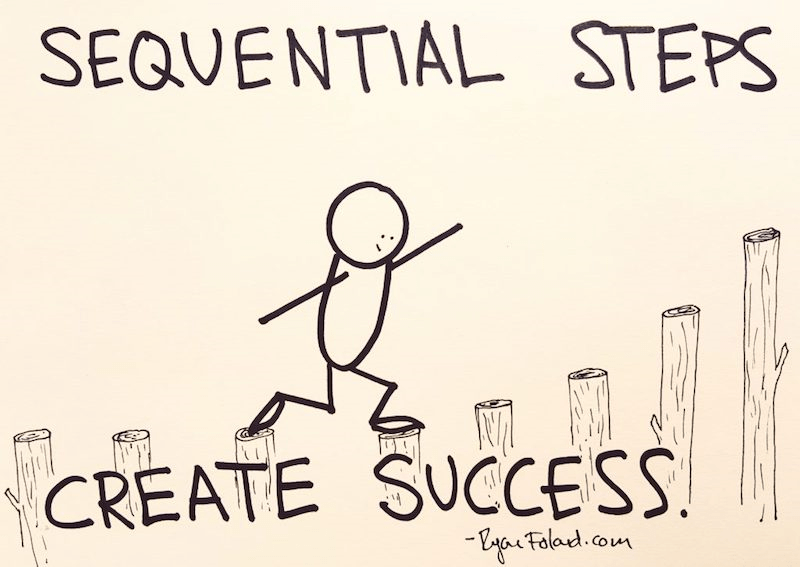
Think of the sections of your talk as sequential steps. One thing Leonard had a lot of difficulty doing the first time he tried giving his talk, was remembering all the key components in the right order. A TEDx Talk has to be 18 minutes or less, and if you are not an experienced speaker, this can seem like forever. It is intimidating to memorize every little piece of it, and Leonard seemed pretty stressed out. There are no scripts allowed on the TEDx stage, but how was Leonard going to memorize it all?
If he tried to remember the entire talk, from start to finish, it was going to be impossible for him. Also, if we decided to change elements, it would mess him up. So, what I did is I drew a few boxes on the whiteboard for him. Five boxes, to be exact. I broke down his story into five different pieces. Five different chunks of information that were smaller sections that he could more easily remember. This simple step made the long talk, a lot more digestible for him.
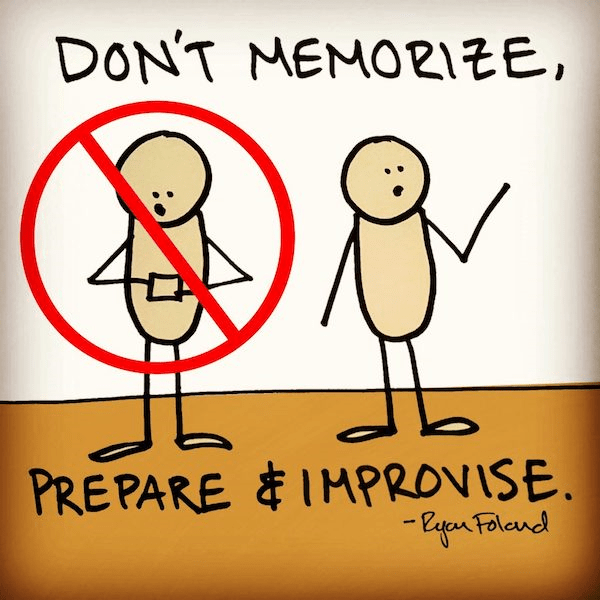
By making it more digestible, he was able to recall and remember things much quicker, and we were able to focus on each section at a time. Whatever the length of your talk or presentation, try to break it down into smaller elements to make it easier for you to work with. Don’t memorize. Prepare and improvise.
Many people think having to memorize speeches is as exciting as being chased by a bear. But you should not memorize your speeches. Instead, you should prepare and improvise. This is one piece of advice I give very often, and was very relevant for Leonard’s talk. He was trying to memorize his whole talk, and it was very obvious.
During rehearsals, he would almost sound like a robot, rehearsing what he had memorized. When he forgot sections of it, he would stop, and lose his place. The downside to memorize a talk word for word is that it can work against you. If you forget one part, it might mess you up, and create a very awkward moment during your talk.
The best way to prepare for a talk is to not memorize but prepare and improvise. Each time you give your talk, it should be a little bit different. You should know the core elements, and explain things in a certain order, but it should be natural sounding, and not like you have memorized every word. For more insights on how to better prepare for a talk, see another article I wrote that outlines everything you need to develop an epic TEDx talk. Practice, practice, practice.
I told Leonard to practice every day. I would call him and ask if he had practiced that yet, and most of the times he said he hadn’t. This is a pattern all too familiar with beginner speakers. If you are trying to prepare for a speech, the best thing you can do is practice. And the easiest thing to do is to not practice. So, I knew I had to keep Leonard accountable. I would send him a text message, or call him every single day to make sure and hold him accountable for practicing.
The acceleration that I saw in improvement came when Leonard started to practice consistently. I would make him call random people, and give the talk to them. I would have him videotape himself and then watch it. I would even tell him to practice his talk in front of stuffed animals.
If you’re just rehearsing the same speech in the same way at the same location every time, it will become monotonous. You have to change up how you practice. Practice in different locations, to different people, and at different times of the day.
-Break it down into three segments:
-Practice in front of friends
-Practice in different locations
-Practice in front of different sized audiences and groups
His talk ended up being funnier than he thought, but he wasn’t thrown off guard by the audience’s laughter, because giving his talk was so natural, since he had practiced, practiced and practiced. Forget everything you’ve learned, and just go with it.
When you grow up, and as you get advice from people, you will get conflicting advice. Some people might tell you to do one thing, some people might tell you to do the other. But you have to, at the end of the day, trust your instincts.
As you can imagine, 24 hours before Leonard’s talk, he was pretty nervous. He probably was scared. And knowing him, I’m sure he wanted to run away, because that’s the type of guy that Leonard is.
I could tell Leonard was nervous. I even saw some social media posts, where he was talking about how nervous he was. But, the time had come for his speech, and he had put in the work that he needed to put in. It was showtime. When it’s getting down to go time, and you’re a day before the event, that’s when you should relax and enjoy all the hard work that you’ve put in.
Forget everything that you’ve been trying to do, and just be natural.
You’re not memorizing, so you’re not repeating a memorized speech. You know what your emotions are at different parts of your talk. You’ve practiced this in front of so many different people, there’s a flow to it, and you know it. You can feel it. It has become natural. Each time you practice, the talk is a little bit different, but the core message is still the same. That’s the magic of being a good speaker, is that every time you give a talk, it should be a little different, because it should be natural.
At the very end, forget everything you’ve learned, and just go up there and enjoy yourself. Because what I told him was, regardless of how the speech goes, if you have a good time, the audience will have a good time. And that is because the audience is a reflection of you. You have hundreds of eyeballs looking at you, and they are picking up your every move. They hear not only the words you say, but they see what your body is saying. If they can sense that you’re nervous, they will get nervous for you. If they sense that you’re actually enjoying yourself, they will be able to relax, listen to your talk, and enjoy themselves.
And that’s exactly what happened with Leonard’s talk.
This is how you can be not the best speaker, but give a stellar presentation that is emotional, and tells your story. At the end of the day, if you follow the above 5 steps, you will feel confident when it is time for your TEDx talk, and you step onto the famous red rug.
After you watch his talk, hopefully, you will be inspired. If you are an engineer and don’t think you have what it takes to give a TED talk, think again. Learn from Leonard’s experience. It just goes to show that with the right coaching, even a bad speaker can be good.
If you are inspired to give a TED talk of your own, I have mapped out the steps you need to take to apply, and spread your idea worth sharing.
If you are interested in private coaching for an upcoming speech, presentation or even TED talk, email me at ryan@ryanfoland.com and we can discuss!
Five days before the release of the first iPad, James Murdoch, a high-ranking executive at News Corp., exchanged a flurry of emails with Steve Jobs. Murdoch and Jobs couldn’t reach an agreement that would allow HarperCollins, a publisher owned by NewsCorp, to add its books to the Apple store before the launch.
Their email exchange offers insight into what to do — and what not to do — when writing business emails. Murdoch’s notes are a classic example of how most of us tend to write: long, with multiple ideas and no clear message. Jobs used simple tactics to dominate the correspondence.
Here are five things we can learn from Jobs about how to write effective emails.
1. Have one purpose
The most efficient emails include just one goal or question.
For example, consider these lines from a long email from Murdoch:
If we could offer to you that a certain percentage of releases (>50%) would be available within your pricing structure (< or = 14.99), does that give you enough comfort? . . . But if you were willing to accept that a supplier can exploit other avenues (at prices not disadvantageous to you), with a guarantee of substantial volume through Apple—maybe I could work with HC to get to some common ground. Please let me know. . . But are you willing to accept that a supplier can exploit other avenues…. Please let me know.
What was he asking? There are so many questions that Jobs answered exactly none of them.
Jobs’ response was to-the-point, and he asked just one simple, rhetorical question:
Maybe I’m missing something, but I don’t see any other alternatives. Do you?
It’s easy to imagine he was getting sick of the meandering correspondence.
When you ask more than one question in an email, you run the risk of not getting an answer. A more effective strategy is to make one request per email. If you need to ask another question, wait to get the first response.
2. Keep the design simple
A key to Apple’s success is its relentless commitment to simplicity. This is evident in the smallest design decisions on products, and it’s clear in Jobs’ emails. In Jobs’ emails, there is one common design element that enables the reader to quickly skim the email and understand its main points.
Unlike Murdoch’s emails with their unwieldy paragraphs, Jobs’ emails included lists. He separated his messages into easily digestible points that contribute to the same argument.
Consider using lists or adding space and emphasis in your own emails to drive home your point.
3. Remove filler words
Jobs didn’t use adjectives, adverbs, or other filler words. His sentences were straightforward and concise.
Murdoch’s sentences, on the other hand, were long and clunky. For example: It seems though that we in each one we largely encounter a “take it or leave it” set of terms . . .
Typo aside, here’s what the sentence would be without fillers:
Each discussion gives us a “take it or leave it” set of terms . . .
If you tend to use a lot of adverbs and adjectives — words like “though,” “largely,” “seems,” “that,” and “really” — make it a habit to remove them before you send an email. Reread the edited draft. If an adjective or adverb was necessary, it’ll be obvious, and you can add those back in. This will make your emails clearer and crisper.
4. Use the active voice
Most rules have exceptions. This one does not. Stephen King has a strong opinion on the topic:
Two pages of the passive voice—just about any business document ever written, in other words, not to mention reams of bad fiction—make me want to scream. It’s weak, its circuitous, and it’s frequently tortuous, as well. How about this: My first kiss will always be recalled by me as how my romance with Shayna was begun. . . . A simpler way to express this idea—sweeter and more forceful as well—might be this: My romance with Shayna began with our first kiss. I’ll never forget it.
The passive voice often sounds timid and lacks clarity. For example, consider this line from Murdoch:
In short—we would like to be able to get something done with Apple—but there are legitimate concerns.
Using the active voice would make it a bit clearer:
We want to work with Apple—but there are legitimate concerns.
If you read the sentences side by side, you can see what King means when he calls the passive “weak.” Focus on using the active voice and strong verbs to strengthen your message.
5. Close with your request
In marketing campaigns, copywriters always put the call to action at the very end. The same should be true of emails. Why?
If the request is embedded in the middle of the email, it’s likely to be forgotten. At the end, the recipient has just finished reading and is focused on the next step.
In the emails between Jobs and Murdoch, Jobs’s agenda, or “ask,” was straightforward. He wanted Murdoch’s company on board for the iPad launch. But even though the point was abundantly clear, Jobs still ended on it:
We’d love to have HC among [the other publishers].
The purpose of most emails isn’t this complex. We often use emails to request a meeting, get permission for a change, obtain information, or do other daily tasks. But with a simple ask, ending with your request is even more important. When the recipient dashes off their reply, they’re more likely to respond to the last thing that was mentioned.
It can often feel as if email takes up a lot of our workday. With these simple tips, not only will you simplify your email routine, but you’ll also find you’ll get better results.
Natasa Lekic is the Founder of New York Book Editors, an editorial service that connects authors to veteran industry editors. In other words, they’re nerdy matchmakers.
Understanding the inevitable downsides to launching a business is key to being prepared
Welcome to the world of entrepreneurship, where things don’t go as planned and failure is the path to success. As an entrepreneur, your success depends on your ability to get comfortable with the uncomfortable. Here are a few key things you’ll need to embrace along your journey.
Embrace Trial and Error
Sometimes, you’ll work for months or even years to launch a new product or service and it falls on deaf ear. Business is about trial and error. One of the best ways to get through this period is to learn and move on quickly. A failed launch isn’t an end to your business, it’s an opportunity to not only understand how to run a business better, but also what to avoid.
Know Your Numbers
Don’t get so wrapped up in the passion for your work that you fail to understand the economics behind your business. This includes everything from knowing what it takes to acquire a new customer to understanding how much you need to sell each day to meet your yearly business goals. You need to know your numbers to track potential issues early on and grow your business.
Get Feedback
Although difficult to hear, getting feedback from your customers as well as your employees, must be a critical part of your growth strategy. Entrepreneurs should get comfortable with not only receiving feedback but also asking for it. If you want to take your business to new heights, you may have to pivot. Feedback can help you refine your products or services.
Prepare to Hear “No”
The reality is, you could go through months of rejection without landing any sales or profitable partnership. Just think, Blockbuster CEO laughed at Netflix’s partnership offer, passing up a chance to buy Netflix for only $50 million. Now, Blockbuster is out of business, and Netflix is now worth $70 million. And My Space CEO refused to Buy Facebook For $75 million. Now, MySpace is worth considerably less than Facebook. Get my point? Sometimes no means not right now or not with you. Keep pushing.
Learn how to keep yourself motivated and surrounded by positive people who have experienced a similar entrepreneurial path.












 Lucidity SBM