4 Mistakes Determined Entrepreneurs Never Make Twice

learn

By  Daniel Marlin

Learn your lesson the first time.

Everybody has goals, but not everybody accomplishes them. Sometimes all it takes is one mistake to derail your progress and jeopardize everything you’ve worked so hard to achieve.

It is tempting to give up during challenging times. Many people do. But if you have the grit and determination to persevere, you’ll find that every mistake contains a valuable lesson that’ll make you stronger, more focused and hard to stop — as long as you don’t make the same mistake again.

Here are four mistakes that determined entrepreneurs never make twice.

1. They always set boundaries.
“No” isn’t always an easy word to say, especially to your customers. We live in a world where businesses put their customers on a pedestal. Entrepreneurs learn that “the customer is king.” No wonder they feel obligated to indulge unreasonable customer demands. That’s why it’s important to set boundaries for your customers.

Your unwillingness to tell them “no” will threaten the control you have over your business. You’ll lose your focus by making other people’s problems your own. Your operation will fall into disarray.

Setting these boundaries is challenging, but it’s possible to assert your authority without being disrespectful. Enforce a set of policies within your business and stick to them.

Understand that some people will disagree with them, and there will be conflict. When customers challenge your policies, explain why a rule exists. Be honest about the extent to which you’re willing to accommodate them. Walk away if they’re still unsatisfied. Sometimes it’s better to take a short-term loss if it means avoiding a much more complicated set of problems in the future.

2. They never underestimate timelines.
Entrepreneurs are naturally optimistic, and that’s great. But, this tendency to be optimistic can result in unrealistic projections about the time it takes to complete specific tasks. This is a psychological phenomenon known as the “planning fallacy.” Even though we’ve done a task a thousand times before, we still underestimate the amount of time it takes to complete it. And this can stop us from organizing our days efficiently and setting realistic deadlines.

That’s a problem because deadlines help create expectations. If they’re lenient, team members become unmotivated and unproductive. But if they’re too tight, people will become stressed and overwhelmed.

Driven entrepreneurs know that even routine tasks contain hidden surprises. That’s why they need to manage their time in a way that creates realistic expectations while leaving room for unexpected challenges.

3. They don’t try to do everything themselves.
You’ve got a qualified team, yet you complain about how much work you have to get through everyday.

Time is precious. Even if you’re the world’s biggest workaholic, you’ve got other interests to pursue in your free time. So why waste away the hours trying to do everything yourself when there are capable people who could do it for you?

Many entrepreneurs are control freaks and terrible at delegating work. They lack trust in other people’s abilities, or they think that they’re the best person for the job — and that might be true. But as a business grows, there comes a point where the workload becomes too much for one person handle. During this stage, your most important task as a leader is teaching your team how to think and ask questions for themselves.

You need to set expectations and objectives, but your team members need to be autonomous so that you’re not micromanaging them. Failing to delegate will cause your business to stagnate and put unnecessary stress on your shoulders.

4. They avoid making enemies.
Competitors are not your enemies. If you focus all your energy trying to beat them, you’ll lose sight of what matters in your business — making customers happy. Now that doesn’t mean you should ignore industry trends and live in a bubble. But you shouldn’t develop unhealthy obsessions about constantly getting ahead of people you have set yourself up against as an adversary.

Instead, spend your time identifying what problems your customers need to solve. Develop products and services that they love using, and create experiences that they keep coming back for. If you keep improving your products, logistics and company culture, you’ll become a leader in your industry without ruffling any feathers in the process.

Mistakes are an unavoidable part of life. But they can cause considerable damage if you don’t change the behavior that causes them to re-occur. Learn from your shortcomings, understand your weaknesses, and dedicate yourself to constant improvement. It’s the only way you’ll solve your problems for good and achieve the determination you need to reach your goals.


Too much experience is a good thing: the rise of the midlife entrepreneur

Research has found the over-50s are setting up businesses faster than any other age group

By Suzanne Mountain

too much

Many women start the businesses they have been dreaming of after their children leave home. Photograph: Alamy

In 2016, my 30-year corporate career in human resources came to an end and, armed with my redundancy package, I started my own coaching business. Little did I know that I was becoming part of a bigger movement, where growing numbers of midlifers have become self-employed.

A recent survey conducted by the Centre for Economic and Business Research found that 45% of all self-employed people are now over the age of 50 and that, as a group, we contribute more than £119 ($156)bn to the UK economy every year. We’re setting up businesses faster than any other age group and employ nearly 10 million people – almost 2 million more than the under-50s.

With over 30 years’ experience of talking to people about life choices and careers, I have observed a number of trends with my generation. Baby boomers have increasingly become disillusioned with the culture of large organizations. Flatter organizational structures, bottlenecks with too many senior candidates, and too few leadership positions have changed the world of work for many. Those of us who started our careers aspiring to receive the long-service pocket watch have realized the notion of a job for life has long since disappeared.

Although illegal, age discrimination is still rife. Middle-aged candidates are often told they have “too much experience”, “will get bored quickly” and that they are “too big for this role”. Many midlifers have been overlooked for promotion, in the face of a dramatic reduction in the average management team age, as companies obsess about bringing in fresh young talent. We have an aging population and yet so many brilliant people in their 50s are being overlooked.

This has left my generation feeling distrustful, fearful and defensive of the employment market and determined to take back control. When many find themselves in a position where they’re offered redundancy, they take the money and run – not to the job center or an online job board but to their spare bedroom, to create the lifestyle they want.

If you are in your 50s and considering setting up your own business, here is a reminder of your best assets and how to use them:

Your experience: Your significant knowledge of an industry or sector will serve as credibility in those early days when you are just starting out. Being adaptable is key and, at this time of life, we have had plenty of experience of being just that.

Your network: After years of working, you will have built up a large network of contacts who can assist you with your new venture. These people do not need to be clients but may have access to people who can become clients, investors or mentors.
Your ability to raise funds quickly and easily: Many people in their 50s will have small mortgages or none at all. Plus new rules mean anyone over 55 can access their pension pot, which could provide valuable startup capital.

Your balancing expertise: Over the years, midlifers have balanced full-time working with raising young families and caring for ageing parents, so being able to balance your new business with other aspects of your life is well within your toolkit. If the children have now left home, many women finally make the decision to set up the business they’ve been dreaming about for a long time.

Your desire to make a contribution: Psychologist Erik Erikson coined the term “generativity” back in the 1950s. It’s the desire to give back to society with work that is more than just a job and a pay cheque. I find that when imagining their new businesses, my coaching clients often talk of their desire to realize unfulfilled dreams, leave a legacy and do something they always wanted to do. Understanding your purpose and building a business that satisfies this while giving back to others can be a powerful motivator.

Suzanne Mountain’s is a business coach to midlife individuals.


A Kitchen Entrepreneur Turned Millionaire Offers 1 Secret To Success

Carmine_JoMalone

Gallo Communications

 “You might leave your passion, but it doesn’t leave you.”

By Carmine Gallo

Jo was fifteen when a teacher told her that she wouldn’t make anything out of her life (Jo had dyslexia, a largely misunderstood condition at the time). She dropped out of school, but was determined to prove the teacher wrong.

Today, Jo Malone is the name behind a fragrance empire. The British perfumer and entrepreneur launched Jo Malone London from her kitchen table and sold it to Estee Lauder for millions. I recently met Jo Malone at a book festival in Dubai, where we both were invited to speak. As we sat on cushions in the desert enjoying a traditional Arabic feast, Malone expanded on the story that she wrote in her autobiography, Jo Malone: My Story.

Finding and following a passion, she said, is critical to success as an entrepreneur or leader. “You might leave your passion, but it doesn’t leave you.” At an early age Malone discovered that she had an acute sense of smell while helping her mother mix creams and fragrances for a skincare clinic. Malone couldn’t read the labels on the jars, but memorized every ingredient by smell.

Malone launched her own fragrance brand in 1988. She began combining ingredients at her kitchen table with four plastic jugs and two saucepans. She started with twelve clients who bought her homemade skin creams. A scent she invented called Lime Basil & Mandarin put her on the map. “Fragrance not only flooded me with ideas but it made me feel complete, fueling an almost obsessive drive of creativity,” Malone writes in her book. “I see smells in colors and memories, and I hear tunes when conjuring a scent.”

When I met Malone, she was no longer associated with the very brand that carries her name. Malone had parted ways with Lauder in 2006 and signed an exit agreement that barred her from the fragrance industry for five years. She soon realized she had made a mistake because “the hunger and spirit” never left her.

In 2011, Malone launched a new brand that sells fragrances in store and online: Jo Loves. Although she was more than 20 years removed from mixing fragrances in her kitchen, she found herself back in a kitchen, doing what she loved — mixing and matching scents to capture the emotions she feels. Malone re-trained herself. “I’d sit for hours with fragrance sticks — one in my left hand, one in my right — wafting them beneath my nose, seeing what the combinations would trigger.”

The secret to success and the secret to reinvention in the second chapter of one’s life is to stay true to the path that your heart puts you on. Malone writes, “I may no longer own my old brand but I remained Jo Malone, the person; that’s who I am, a creator of fragrance…trust in the one thing you’re good at.”

Malone reminds us that all too often, we’re pulled in many directions. A friend gets a job in a hot industry and convinces you to follow his path, a colleague starts a company and wants you to join her, a boss invites you to fill a position that has a more prestigious title, but takes you away from what you enjoy.

Malone says in those situations, the best advice she can give is the one she’s learned from going from kitchen entrepreneur to millionaire: “Follow your heart. If you wake up each morning with a drive rooted in the passion of what you do, rather than a passion for the money you can make, you’re on a wise path.”

Carmine Gallo is a keynote speaker, communication advisor and bestselling author of The Storyteller’s Secret, now available in paperback. Sign up for his newsletter at carminegallo.com.


10 Mistakes You’re Making With Google Analytics

google

Image credit: GongTo | Shutterstock.com

By Aj Agrawal

What? You’re not using this tool? Then, you’re missing out on your best opportunity to unlock the full potential of your website.

Google Analytics – https://analytics.google.com/analytics/web/provision/?authuser=0#provision/SignUp/ – has proven time and time again that it’s one of the best marketing tools out there. With its detailed and user-friendly reports about what’s happening on a website, and why, Google Analytics is a great tool for marketers to understand what their audiences look like, as well as which strategies are working and which aren’t.

Since this tool is so helpful, it’s especially important that you use it correctly to achieve its fullest potential. Here are some common Google Analytics mistakes to avoid in order to ensure that you’re getting the most out of this powerhouse.

1. Not using Google Analytics in the first place
As many as 30 to 50 million websites use Google Analytics. If your site isn’t one of them, you risk missing out on one of the best applications for analyzing your web traffic.
Without using Google Analytics or another tracking platform for your website, it’s nearly impossible to know what marketing strategies are working — especially on the individual page level. By being able to look at how each page performs, you can make nuanced tweaks to improve your business strategy.

2. Not filtering out internal session data
For a large organization, thousands of page views per month might come from you or your employees. This internal activity can skew your data and give you an inaccurate idea of your website’s performance. So, it’s important to set up a filter to remove this information from your results so that the analytics you’re examining are as accurate as possible.

3. Not filtering out spam traffic
Some 4 percent of all internet traffic comes from spam; this might seem like a small percentage, but it can translate into a significant number of meaningless page views for your website.

Even if you’ve already implemented tools to block spammers, you’ll still want to filter out spam traffic to keep your data accurate. One way to do this is to apply the Segment to Eliminate Spam Referrals” by Analytics Edge in your Google Analytics.

4. Misusing Urchin Tracking Module (UTM) parameters
A UTM parameter is a sort of tag that you can add to URLs to help you see where your web traffic is coming from. For instance, if you’re putting up ads on different websites, using UTM parameters will help you see which ads are doing a better job at driving traffic to your site. This is how you can find out statistics, like the fact that 31.24 percent of all referral traffic in 2014 came from social media.
With that knowledge under your belt, you can adjust your marketing strategies accordingly.

5. Using only aggregate data
If you don’t segment your Google Analytics data based on factors like demographics, behaviors and geography, you’re missing out on a ton of valuable information. For example, 72.5 percent of the Huffington Post’s web traffic comes from the United States, so that publication probably caters a lot of its content to the U.S. audience.
By segmenting, you can gain similar insights into your own website to better tailor your content and reach more people.

6. Not setting up goals
This one goes back to that old Harvard study that found that having goals makes you 10 times more successful than the alternative. As a marketer or executive, you certainly do have goals: to generate leads, improve customer engagement and make sales, for starters. In Google Analytics, you can also set up such goals as increasing white-paper downloads, getting more people to click on a certain page or encouraging more contact forms.
The tool will show you your progress so that you can make adjustments as needed.

7. Not tracking conversions
Some 22 percent of marketers report being dissatisfied with their conversion rates. To avoid this, use Google Analytics to help track this aspect of yourr users’ journey. Without conversion data, you’ll have an incomplete picture of your website’s performance; after all, the site’s main goal should be to increase those conversions.
By setting up a conversion goal in Google Analytics, you can see where the conversions came from, what pages on the site users have visited most and what got them to fulfill the conversions you attained.

8. Not tracking events or campaigns
Some 64.6 percent of people click on Google ads when they’re looking to buy an item online. So, given this context, if you aren’t tracking your own campaigns, you won’t know which ad campaigns are working and which aren’t.
Google Analytics provides you the source of your referral traffic, as well as specific campaign-tracking variables. You can also track events like email clicks and video views.

9. Comparing apples and oranges
It’s imperative that you look at comparable data in order to make conclusions about trends regarding your web traffic. For example, if you’re comparing conversions in two different months, it’s possible that holidays or other events are affecting those conversions — making it difficult to compare the two directly.

This apples and oranges issue is a common one in many scenarios: Remember how many mainstream polls gave then-presidential candidate Donald Trump a mere 28.6 percent chance of winning? Since those polls were comparing data from sources that couldn’t be compared — i.e., the demographics of liberal and conservative voters — many polls were faulty. Don’t make a similar mistake when making decisions based on your Google Analytics information.

10. Ignoring the Solutions Gallery
Only around 5 percent of the U.S. population can be ranked at the highest level of computer literacy; the rest of us need help sometimes when running our websites. And, here, Google Analytics can get tricky, so it’s a big mistake to not use its Solutions Gallery, which provides access to custom reports and dashboards to help you navigate website issues.

There are a huge number of ways to use Google Analytics to your advantage — and a lot of ways to make mistakes with it, as well. By avoiding these common pitfalls, you’ll get closer to unlocking the full potential of your website.

Entrepreneurs Can Buy Happiness, According to a New Study

spend money

Image credit: iStock / Getty Images Plus

By Rose Leadem
Online Editorial Assistant
Rose Leadem is an online editorial assistant at Entrepreneur Media Inc.

A new study reveals that to be happy and less stressed, spend money on saving time.

Luckily today, with companies such as TaskRabbit and Uber, it’s become easier to pay someone else to do these tasks for you and buy yourself more time to work on your business. It will cost you — but it turns out many people are willing to pay. And that’s a good thing, according to recent research.

The study, published in the Proceedings of the National Academy of Sciences, found that people who spent money to save time were less stressed about how much time they had, and as a result, were happier.

If you’re stressed about drafting a pitch, coding your website or securing funding, doing small tasks such as grocery shopping and cleaning can sound like time-sucking nightmares. The good news is: outsourcing time-consuming tasks can not only give you the time to do what you do best, but keep you smiling.

“Money can buy happiness if you spend it right,” said Elizabeth Dunn, University of British Columbia psychology professor and co-author of the study.

In the study, researchers conducted a series of surveys with more than 6,000 people in the U.S., Denmark, Canada and the Netherlands to understand how a person’s spending habits affects the way they feel.

Overall, those who spent their money on things such as ordering takeout, taking a cab and hiring household help reported greater life satisfaction than those who spent their money on other things.

As entrepreneurs, time is extremely valuable — however, so is money. But the study found that whether a person was rich or poor, spending money on saving time boosted happiness levels.

“If there’s some task that just thinking about it fills you with dread, then it’s probably worth considering whether you can afford to buy your way out of it,” Dunn said.

So does that mean money can actually buy happiness? No. Buying new clothes, gadgets and other stuff doesn’t in fact make you happier — only buying time does. To test this, the researchers conducted another experiment where they provided participants $40 on two consecutive weekends and instructed them to spend the money on either material or timesaving purchases. Participants were asked their mood at the end of the day, and those who spent their money to save time were found to have less time-related stress and increased well-being. Material purchases did not have this effect.

Yet, whether you’re a busy entrepreneur, an employee or a c-suite executive — it’s important to be mindful of the tasks you outsource or automate. While we have the resources to automate nearly everything today, doing tasks such as cooking and driving can help you build a diverse set of skills and give you opportunities to spend quality time with your significant other or family members.

4 Ways Entrepreneurs Can Work Less for More Success

entrepreneur-philosophy-successful

Image credit: Shutterstock

By Elise Mitchell CEO of Mitchell Communications Group

“Work” may be the mantra of high-achieving entrepreneurs, but “rest” is what will really propel you to new efficiency heights. 

The struggle to succeed in business is often likened to the training required for an IronMan triathalon. Athletes and entrepreneurs alike are high achievers — exemplars of grit and determination. But, just as marathoners include rest days in their training programs so their muscles can recover and become stronger, so should entrepreneurs “work smarter” by working less.

In their new book Peak Performance: Elevate Your Game, Avoid Burnout, and Thrive with the New Science of Success, Steve Magness, a professional running coach, and Brad Stulberg, an expert in the science of human performance, assert that rest is crucial to forward progress across various endeavors — especially those of the business variety.

You won’t grow your business by running on fumes all the time. Instead, refilling your tank is the ticket, the authors argue. It’s part of the work.

Of course that’s easier said than done in a culture that rewards those who burn the midnight oil. Couple that with such inner drivers as ambition, guilt and a desire to prove our worth, and it makes sense why we sometimes feel the need to work excessively.

In fact, this tendency is one of the biggest mistakes entrepreneurs make. A study by John Pencavel of Stanford University linked work hours and productivity. He found that output for an individual drops after a 50-hour work week. “I really don’t need much sleep,” claims many a high achiever. But that’s simply not true. And the Stanford study wasn’t alone in saying this: The Wall Street Journal reported other research saying that 98 percent of people suffer diminishing performance on six hours of sleep or less a night.

The answer isn’t to forego work for sleep or vice versa. It’s to make sure you have the right amount of time for both. By learning to work smarter, you can become a better leader — and a healthier one, too. Here are four ways to work less and achieve more.

1. Jump-start the multiplier effect through delegation.
If you’re anything like me, you often have to resist the urge to bootstrap everything yourself. You’ve built your startup from scratch, invested your personal wealth and assumed ultimate accountability. Who could blame you for wanting to hold on to that?

You may be able to complete certain tasks more efficiently, but you cannot do everything better, faster and smarter. Passing on tasks empowers others, gives you new perspectives and brings new skills to the table because of the broader team that’s been engaged. That’s when the “multiplier effect” kicks in.

The multiplier effect is “you” times the number of people whom you effectively coach and empower, to spur greater output. In short, there’s no need to work 24/7, because you have capable people around who have the tools and resources needed to power your company.

Still need convincing? A Gallup poll found that of 143 CEOs surveyed, those with high delegator ability showed an average three-year growth rate of 1,751 percent, which was 112 percentage points greater than that of CEOs with low levels of delegator talent. Additionally, in one particular year studied, 2013, CEOs who delegated enjoyed one-third more revenue than those who didn’t and saw an average $8 million versus $6 million more in revenue.

2. Plan your work; work your plan.
Years ago, I proudly showed my boss a list of goals I was working on, and his response has stuck with me since. He looked at my long list and told me to pick three goals and do all I could do to accomplish them — because they mattered more than the others. His message was clear: I needed to focus my work to deliver where it counted.

Rather than spread yourself thin, identify the greatest value that you can bring to your company. It could be implementing strategy, building relationships or securing resources — but it shouldn’t be all three at once. According to neuroscientist Earl Miller, “People can’t multitask very well, and when people say they can, they’re deluding themselves.”

Next, determine the greatest value that you can bring to the company today. This will constantly change. For example, you may need to attract new clients, but several months from now, you may need to focus on recruiting new staff instead. The future of your business depends upon your ability to look through the turn, as I often say. Examine market trends, the competition and how technology is impacting your industry.
By looking ahead, you can pinpoint exactly what you should focus on next month, next quarter or next year.

3. Introduce “no” into your vocabulary.
As a leader, the opportunities come flooding in — from volunteering on local boards to attending social events to writing a book. Saying “no” more often than “yes” is vital to preserving the time you need to devote to your business.

Steve Jobs was a skilled practitioner at the art of saying “no.” He’s quoted as having said: “I’m actually as proud of the things we haven’t done as the things I have done. Innovation is saying ‘no’ to 1,000 things.”

Still, saying  no is hard. We hate to disappoint bosses, colleagues or friends. Research shows we’re hardwired to please, but doing so can backfire because it leads to overcommitment.

To prevent becoming a yes man (or woman), compile a list of criteria to use to vet opportunities. Tie each opportunity back to the value that you bring to your company today. For instance, if you’re focused on hiring right now, consider whether the opportunity before you helps raise visibility for your company.

You don’t have to close the doors on opportunities forever. Rather than saying “no” outright, say “not now.” Next time people approach you with an amazing opportunity you don’t have capacity for, tell them you can’t commit right now but you’d like to be reconsidered in the future.

4. Work to live — don’t live to work.
Workfront’s 2015 State of Enterprise Work report found that Americans spend only 45 percent of their working hours doing the primary duties of their job. The rest of the time is spent on checking emails, nonessential tasks and meetings. The most successful people I know, however, schedule “me time,” too. They understand that this provides a buffer that will never be captured unless it’s planned.

Twice a week, block off 30 minutes to an hour on your calendar. Set aside email and your phone. Use the time to focus on a complex problem, develop a new strategy or reflect on a situation you could have handled better. Your personal life is also a priority. Appointments, family events and vacations should be on your calendar well in advance so you can plan around them.

According to Dov Frohman, former vice president of Intel, “Every leader should routinely keep a substantial portion of his or her time — I would say as much as 50 percent — unscheduled. Only when you have substantial ‘slop’ in your schedule . . . will you have the space to reflect on what you are doing, learn from experience and recover from your inevitable mistakes.”

“Work” may be the mantra of high-achieving entrepreneurs, but “rest” is what will really propel you to new efficiency heights. You can do less and achieve more.

Trying to be a Naive Entrepreneur again

Don’t let your experience get in the way of starting a company

Naive I

“Two roads diverged in a wood, and I — I took the one less traveled by, And that has made all the difference.” The Road Not Taken by Robert Frost

By Robbie Allen

Once I decided to step back as CEO of Automated Insights, I started to think about what I was going to do next. Should I immediately start another company? Should I consult for a while? Should I take some time off? Ultimately, I chose to take the summer off and go back to school.

I’m in the prime of my career. Why wouldn’t I start another company now and try to repeat some of the success we’ve had with Automated Insights? Two things were holding me back.

First, I wanted some time to dig into the latest AI research. There had been a lot of advances in AI since I attended MIT in 2005, and I wanted to focus on learning and understanding where things are going. I’ve written about why I think AI is different than previous technology waves.

Second, for any new business idea I came up, I quickly convinced myself why I shouldn’t do it. Idea 1 will be too hard to monetize. Idea 2 was tried by a company last year and failed. Idea 3 will require too much capital. etc. etc. etc.

I found my experience was getting in the way (h/t Mark Suster) of me being naive enough to start another company. While there are some distinct advantages, in many ways, starting the second company is harder than the first. I learned a lot about what works and what doesn’t when it comes to building and running a startup over the last ten years, and it was getting in the way of starting the next one.

To be young (and naive) again

The conventional wisdom is that young, early-twenty-something entrepreneurs are the ideal. The thinking goes that young entrepreneurs don’t have the burdens that come with later adulthood like a mortgage, family responsibilities, and particular lifestyle to maintain. They can be ramen profitable and happy while working 80 hours a week, every week. They can “go big” and not risk much.

To a certain degree that is true, but I don’t think it captures a young person’s primary advantage. The biggest asset an entrepreneur can possess is a naive optimism about their idea, and most early twenty-somethings have that in spades.

What do I mean by naive? I like Merriam-Webster’s definition:
na·ive (nīˈēv); adj
deficient in worldly wisdom or informed judgment

You are naive because you haven’t been there and done that. You lack experience in the field. You don’t know what you don’t know. And that’s exactly what entrepreneurs need.
Why is that important? If you knew better, you probably wouldn’t (or shouldn’t) start a company in the first place. Most ideas are not unique. What makes you think this time your idea will work when others have tried before and not succeeded?

I’m not one of those entrepreneurial pessimists that harp on startup failure rates and the difficulty with running a company. Actually, I think being the CEO of a startup is the best job in the world. However, it is a challenging line of work, and a lot has to line up in your favor (including “luck”) for things to work out well.

Being unaware of all the potholes and landmines that can derail you is a major advantage. When it comes to being an entrepreneur, ignorance is bliss. You need to be able to try paths that have been attempted before and failed. In some cases, you need to head to the edge of a cliff not knowing if the next step is a dead-end or the beginning of a new journey.

Naive II

Photo: Cas Adams via Unsplash

The same thing happens to physicists

Last year, I read an interview with noted physicist Freeman Dyson where he explained why the great breakthroughs in math and physics happen by people under 30. It’s the same issue as what I’ve described happens to repeat entrepreneurs.
It’s not because older physicists have less mental horsepower but as Dyson puts it: for theoretical physics, I suppose you need to be ignorant. After a while, you get so attached to things as they are.

Here is an excerpt from the interview:

Is physics a young person’s game? It seems that most great discoveries are made by people under 40 or even under 30.

That is true in theoretical physics. Experimenters can keep going much longer and sometimes stay very productive into old age. That’s a very different game. For theoretical physics, I suppose you need to be ignorant. After a while, you get so attached to things as they are.

I thought you’d say we have more brain power when we’re young. But you’re suggesting the problem is we get too set in our ways.

I would say so. Of course, I don’t know how to measure brain power. I certainly am slowing down and that’s quite noticeable. I can’t measure how much brighter I used to be than I am now.

Was there a certain point in your own career when you stopped doing the kind of mathematical physics you had once done, when you decided to go in a different direction?

Yes. The turning point was around the age of 45. The middle-age crisis is when you suddenly become aware of the fact that you’re not as smart as your students. At that point, I decided to spend the second half of my life mostly writing books rather than doing calculations, which was a wise choice. Most people become administrators or do something else then. You have to find another line of work rather than just thinking.

Finding the sweet spot: Being naive while leveraging my experience

After a couple months of evaluating business ideas, I decided that I needed to step back from what I was doing. I needed to take advantage of the expertise and skills that I built over my career, but in a new way that was unlike anything I’d done before.

One option I’ve considered is targeting a completely different market like healthcare. It’s a space I’m not intimately familiar with but is brimming with opportunities. Plus, there are plenty of people that will tell you it’s a horrible industry to start a company in due to the monopolistic incumbents and significant regulatory issues. Sounds like a market ripe for fresh ideas!

I’ve also looked at the parental control market, which has poor solutions today. With two small kids, I have tangible needs around limiting screen time. I’ve never worked in that market before, but I have an idea of what is needed.

I’m not starting anything right now, but once I applied the “naive” filter to potential industries, ideas, and markets, it was easier to come up with some options I can get excited about. I’m finding ideas where I’m bringing less baggage because I don’t know what I don’t know and that’s all I need to know.

Appeared in: https://unsupervisedmethods.com/trying-to-be-a-naive-entrepreneur-again-2e03a9a7457e


Want to Be Incredibly Happy? A New Study Says Spend Your Money on This

Happiness

CREDIT: Getty Images

By Wanda Thibodeaux

You’re a smart cookie. You know you can’t make yourself happy by burying yourself in material stuff. But as Karen Kaplan of the Los Angeles Times reports, research led by Ashley Williams of Harvard Business School shows you shouldn’t disconnect your wallet from your contentment just yet. Pay someone to do everyday tasks you think suck–for example, cleaning up your house–and you might just see your joy-o-meter skyrocket off the charts.


Three studies, one uplifting result


Williams and his team surveyed approximately 4,500 people from four countries (the Netherlands, Canada, Denmark and the United States) to find out if they increased free time by paying others do to daily jobs they didn’t enjoy, such as shopping, cooking and household maintenance. About 1 out of 4 respondents (28 percent) said yes. To check the question scope, researchers then conducted a follow-up survey of approximately 1,800 Americans, asking if they spent money to buy more free time. This time, half the respondents said they did. For both surveys, the researchers found that people who bought themselves time were happier than individuals who opted to do their daily work themselves.


To see if they could verify their results further, Williams and his colleagues conducted one final study with 60 working adults. The researchers gave each participant $40 and told them to spend it on something material. They repeated this the following weekend, but this time, the researchers had the participants put the cash toward something that would give them more free minutes. The participants were happier when they spent the money on time-saving purchases.


Why shelling out cash for service cheers you up


Williams and his team assert that participants in the studies likely enjoyed better moods when they could pay others to do daily work because people become stressed by their perceived lack of free time. But why exactly does no free time translate to stress and unhappiness? That’s a little murkier, but there are at least four possible explanations.


1. Fear of messing up and being alone–When you don’t have any extra time, on some level, you probably recognize that there’s no real wiggle room to fix any mistakes you make. You might become anxious because you don’t want the negative judgment, rejection and isolation that potentially could come if you screw up and can’t fix it.

2. Inability to be yourself–What you do with free time says something about who you are. That is, it’s an expression of your personality, dreams and abilities. If you never get a chance to reveal yourself because “dumb chores” are holding you back, you’ll likely feel like life is unfair and has no real purpose, or that you’re little more than an imposter.

3. Poor control–People naturally want to have a say in what they do or what happens to them because it makes them feel safer, like the alpha rather than the beta. Having so much on your plate can make you feel like someone else–or even just the almighty, nameless powers that be–is calling the shots. That shatters the sense of security being able to allocate your time offers.

4. Thinking you’re missing the boat–Any time you spend time doing a chore, there’s an opportunity cost. You trade what you could have liked for getting the work done. At the back of your mind, you might be sad and frustrated that you’re not having those alternate experiences, worried that you’re not living to the fullest or keeping up with the Joneses. Fear of missing out (FOMO) is particularly severe among millennials, who compulsively connect to technology to see what’s happened or what others are doing.


Paying someone to do some of your chores doesn’t necessarily mean life suddenly will be perfect, but it gives you the feeling that you’re on freer, more stable, balanced ground and aren’t losing out so much. It puts choice, independence and individuality all back into the picture. And voila. Happiness comes back, too.


The big takeaway


Whether it’s paying someone to mow your lawn or splurging on a meal kit service so you don’t have to grocery shop after work, paying someone to do things for you isn’t sheer laziness. It’s a legitimate way to buy back a little joy. Just be realistic with your budget and, if cash is tight, concentrate on eliminating the top one to three time vampires out of your life.

6 Honest Truths About Failure That All Entrepreneur Should Embrace

failure getty picture

CREDIT: Getty Images

By Peter Gasca

Failure is a scary, seven-letter word that no aspiring entrepreneurs likes to hear. The truth is that no entrepreneurial journal can be complete without it.

One of the biggest factors holding back new and aspiring entrepreneurs is the fear of failure.

The reality is that the vast majority of successful entrepreneurs have, at one point or another, failed at some kind of business challenge. Personally, I have had more business failures than business successes, and even in the successful businesses, I can reflect on countless mistakes and failures along the way.

Failure should not be perceived as an end to the entrepreneurial journey, but rather a meaningful and beneficial part of it, and when accepted and embraced, failure can help you find the confidence to start and find your groove.

Here are six honest truths about failure you should know.

1. Success comes from failure.

If you have ever had your heart broken, you know that recovery is long and painful. What heartbreak does, however, is helps you shape your understanding and appreciation for those to whom you open your heart.

Failure is very similar. Without failing from time to time, you can never understand what success truly looks like.

2. Failure comes from curiosity.

Most entrepreneurs venture out because of an insatiable thirst for knowledge and desire to reach their full potential. Entrepreneurs are the type of people who must touch the handle of the frying pan, even after countless warnings about it being hot — because they want to know for themselves.

This curiosity leads us to seek out answers and take more risks, all of which naturally lead to failure (and burn blisters) through trial and error.

3. Failure is an asset.

One of the most important — and least recognized — considerations is that failure means that you tried. Compare to those who never try, and as long as you are learning along the way, entrepreneurs become more valuable with each and every failure.

4. Nobody wants you to fail.

Personal pride aside, the reality is that nobody wants you to fail in your endeavor. All stakeholders, from lenders to vendor to customers, all have a vested interest in your business and your success. If you have developed strong relationships through honesty and transparency, most of your partners will work with you through difficult times.

Mutual success benefits everyone involved.

5. Failure is not quitting.

Failure should never be confused with quitting. Failure is a roadblock. Quitting is when you stop trying altogether.

6. Each failure gets easier.

To use the heartbreak analogy again, if you have had your heart broken more than once, then you know that each disappointment gets a little easier to accept and get over. In fact, more experience with heartbreak and disappointment helps you get better at managing the process as a whole. Entrepreneurship is no different, and most serial entrepreneurs I know see failure as just another disappointment.

If the fear of failure has been keeping you from pursuing your entrepreneurial aspirations, just understand that failure is one of the most important aspects of the entrepreneurial journey. If you learn from it, manage it, and understand how it can make you better, it is also one of the most beautiful and inspiring aspects.


Analysts, Not Accountants, Are Most Sought After for Small Business Finance

“Every spreadsheet tells a story” 

Most-in-demand-SMB-finance-roles-1-850x477

by Joshua Sophy

In today’s small business world, the person who keeps track of the numbers may be less important than the person who can tell you what those numbers mean.

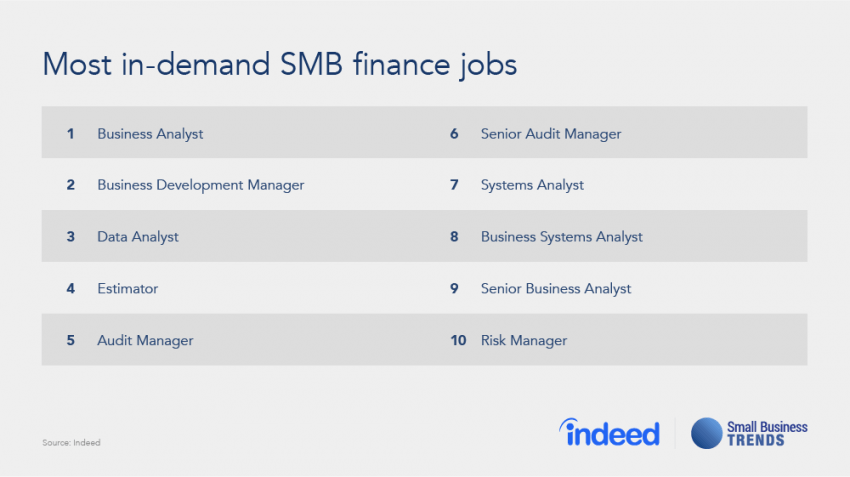
New data from the jobs site Indeed.com reveals that among the top 10 in-demand finance jobs, not a one is an accountant. The number one, most in-demand job wanted by small businesses is business analyst.

Small Business Analysts in High Demand

In fact, half of this top-10 list from Indeed is filled with analyst jobs. It shows that small businesses don’t need help counting the beans; they need help analyzing those beans to figure out how they can help the company’s future.

After Business Analyst in the top spot, the most in-demand small business job in this sector, Data Analyst comes in third. Systems Analyst, Business Systems Analyst, and Senior Business Analyst finished seventh, eight and ninth on the list from Indeed, respectively.

“It is interesting that we are seeing business analysts rise to the top of this list, as small businesses have traditionally relied on accountants in their growth phase,” said Indeed SVP of HR, Paul Wolfe. “The healthy economy brings a need for companies to know where their business is thriving financially (or not) to help make decisions for the future.”

The use of cloud services and small business automation technology has been a boon for small businesses. Tasks that typically required at least one employee — like accounting — can now be handled by an app or other online platform in most instances. But the numbers that those platforms produce still need interpretation.

Small business owners want to know what these numbers mean and how to react to them.

Even the jobs without Analyst in the title are more inclined to give a perspective on numbers.

To create the list, Indeed analyzed postings for finance job titles in the small business sector over the last year. Small businesses were defined as those with less than 200 employees in Indeed’s analysis.