12 lessons you learn or regret forever

12_Things_Regret_Forever-800x450

By Travis Bradberry

Sticking your neck out and taking charge of your career is no trivial matter. Whether that’s switching careers, going back to school, or walking away from a j-o-b to start your own business, it takes a lot of guts.

But guts will only get you so far. Once you build up the nerve and make the leap, you’re no more than 5% of the way there. You still have to succeed in your new endeavor, and trying to succeed is when your worst fears (the ones that made you hesitate in the first place) will come true.

I’m going to assume you’re like me and don’t have a brilliant mentor, a rich uncle, or some other person who is going to show you the ropes and explain each step you need to take to take charge of your career.

You see, it’s been almost 20 years since I last had a boss. I went from working in a surf shop to striking out on my own, eventually starting TalentSmart (with a partner) before I’d finished grad school.

When I set out on my own, I had all the gumption and appetite for risk that I needed to take charge of my career. At the time I thought that was all I needed to succeed.

It wasn’t. I also needed guidance. Without it, I learned some difficult (and often painful) lessons along the way.

I’d like to share some of my biggest lessons learned with you so that they can help you as you take charge of your career (in whatever form that takes). As I look back on these lessons, I realize that they’re really great reminders for us all.

1. Confidence must come first

Successful people often exude confidence — it’s obvious that they believe in themselves and what they’re doing. It isn’t their success that makes them confident, however. The confidence was there first.

Think about it:

  • Doubt breeds doubt. Why would anyone believe in you, your ideas, or your abilities if you didn’t believe in them yourself?
  • It takes confidence to reach for new challenges. People who are fearful or insecure tend to stay within their comfort zones. But comfort zones rarely expand on their own. That’s why people who lack confidence get stuck in dead-end jobs and let valuable opportunities pass them by.
  • Unconfident people often feel at the mercy of external circumstances. Successful people aren’t deterred by obstacles, which is how they rise up in the first place.

Confidence is a crucial building block in a successful career, and embracing it fully will take you places you never thought possible. No one is stopping you from what you want to accomplish but yourself. It’s time to remove any barriers created by self-doubt.

2. You’re living the life that you’ve created

You are not a victim of circumstance. No one can force you to make decisions and take actions that run contrary to your values and aspirations. The circumstances you’re living in today are your own — you created them.

Likewise, your future is entirely up to you. If you’re feeling stuck, it’s probably because you’re afraid to take the risks necessary to achieve your goals and live your dreams.

When it’s time to take action, remember that it’s always better to be at the bottom of the ladder you want to climb than at the top of one you don’t.

3. Being busy does not equal being productive

Look at everyone around you. They all seem so busy — running from meeting to meeting and firing off emails. Yet how many of them are really producing, really succeeding at a high level?

Success doesn’t come from movement and activity. It comes from focus — from ensuring that your time is used efficiently and productively. You get the same number of hours in the day as everyone else. Use yours wisely. After all, you’re the product of your output, not your effort. Make certain your efforts are dedicated to tasks that get results.

4. You’re only as good as those you associate with

You should strive to surround yourself with people who inspire you, people who make you want to be better. And you probably do. But what about the people who drag you down? Why do you allow them to be a part of your life?

Anyone who makes you feel worthless, anxious, or uninspired is wasting your time and, quite possibly, making you more like them. Life is too short to associate with people like this. Cut them loose.

5. Squash your negative self-talk

When you’re taking charge of your career, you won’t always have a cheerleader in your corner. This magnifies the effects of self-doubt. The more you ruminate on negative thoughts, the more power you give them. Most of our negative thoughts are just that — thoughts, not facts.

When you find yourself believing the negative and pessimistic things your inner voice says, it’s time to stop and write them down. Literally stop what you’re doing and write down what you’re thinking.

Once you’ve taken a moment to slow down the negative momentum of your thoughts, you will be more rational and clear-headed in evaluating their veracity.

6. Avoid asking “What if?”

“What if?” statements throw fuel on the fire of stress and worry, which are detrimental to reaching your goals. Things can go in a million different directions, and the more time you spend worrying about the possibilities, the less time you’ll spend taking action and staying productive. Asking “what if?” will only take you to a place you don’t want — or need — to go. Of course, scenario planning is a necessary and effective planning technique. The key distinction here is to recognize the difference between worry and strategic thinking about your future.

7. Schedule exercise and sleep

I can’t say enough about the importance of quality sleep. When you sleep your brain removes toxic proteins from its neurons that are by-products of neural activity when you’re awake. Unfortunately, your brain can remove them adequately only while you’re asleep.

So when you don’t get enough sleep, the toxic proteins remain in your brain cells, wreaking havoc by impairing your ability to think — something no amount of caffeine can fix.

Your self-control, attention, and memory are all reduced when you don’t get enough — or the right kind — of sleep. Sleep deprivation raises stress hormone levels on its own, even without a stressor present, which are a major productivity killer.

Ambition often makes you feel as if you must sacrifice sleep to stay productive, but sleep deprivation diminishes your productivity so much throughout the day that you’re better off sleeping.

A study conducted at the Eastern Ontario Research Institute found that people who exercised twice a week for 10 weeks felt more competent socially, academically, and athletically. They also rated their body image and self-esteem higher.

Best of all, rather than the physical changes in their bodies being responsible for the uptick in confidence, it was the immediate, endorphin-fueled positivity from exercise that made all the difference. Schedule your exercise to make certain it happens, or the days will just slip away.

8. Seek out small victories

Small victories can seem unimportant when you’re really after something big, but small victories build new androgen receptors in the areas of the brain responsible for reward and motivation.

This increase in androgen receptors increases the influence of testosterone, which further increases your confidence and your eagerness to tackle future challenges. When you have a series of small victories, the boost in your confidence can last for months.

9. Don’t say “yes” unless you really want to

Research conducted at the University of California in Berkeley shows that the more difficulty that you have saying no, the more likely you are to experience stress, burnout, and even depression, all of which make it difficult to take charge of your career.

Saying no is indeed a major challenge for many people. “No” is a powerful word that you should not be afraid to wield.

When it’s time to say no, avoid phrases like “I don’t think I can” or “I’m not certain.” Saying no to a new commitment honors your existing commitments and gives you the opportunity to successfully fulfill them.

10. Don’t seek perfection

Don’t set perfection as your target. It doesn’t exist. Human beings, by our very nature, are fallible.

When perfection is your goal, you’re always left with a nagging sense of failure that makes you want to give up or reduce your effort. You end up spending your time lamenting what you failed to accomplish and what you should have done differently instead of moving forward excited about what you’ve achieved and what you will accomplish in the future.

11. Focus on solutions

Where you focus your attention determines your emotional state. When you fixate on the problems that you’re facing, you create and prolong negative emotions which hinder your ability to reach your goals.

When you focus on the actions you’ll take to better yourself and your circumstances, you create a sense of personal efficacy that produces positive emotions and improves performance.

12. Forgive yourself

When you slip up, it is critical that you forgive yourself and move on. Don’t ignore how the mistake makes you feel; just don’t wallow in it. Instead, shift your attention to what you’re going to do to improve yourself in the future.

Failure can erode your self-confidence and make it hard to believe you’ll achieve a better outcome in the future. Most of the time, failure results from taking risks and trying to achieve something that isn’t easy.

Success lies in your ability to rise in the face of failure, and you can’t do this when you’re living in the past. Anything worth achieving is going to require you to take some risks, and you can’t allow failure to stop you from believing in your ability to succeed.

When you live in the past, that is exactly what happens, and your past becomes your present, preventing you from moving forward.

Bringing it all together

I hope these lessons are as useful to you as they have been to me over the years. As I write them, I’m reminded of their power and my desire to use them every day.

Travis Bradberry is the coauthor of Emotional Intelligence 2.0 and the cofounder of TalentSmart.

Please stop bragging about how busy you are

Great article. I have to admit I am guilty of the ‘busy, busy, busy’ syndrome. But now that I’m aware of why I feel the need to always be busy, I will definitely start thinking differently” 

busybusybusy

By Tony Crabbe


“Busy” has become a brand. We moan, brag, and compete about how busy we are.
Many of us are locked in a state of frantic, racing, cramming, skimming activity from the moment we wake up to the moment we go to bed.

But instead of making us more productive, busyness often holds us back. Not only can it make us exhausted and stressed, but it also can prevent us from moving our careers forward.

Here’s why we feel so busy and what we can do about it.

We were trained to be busy

Humans evolved in a world of scarcity, where “more” was a good thing. During the Industrial Revolution, “more” became a battleground cry, and the role of managers was to get people to work more efficiently.

When your start your careers, showing a bit more effort and staying longer are easy ways to signal your commitment, which helps you advance.

But there comes a point where the people with whom you’re competing are also playing the “more” game.

We know from corporate strategy that when both parties try and squeeze more and more out of less and less, they end up stagnating.

We use busyness to feel better

When we talk about how busy we are, we’re often looking for acknowledgment.
We’re desperate for someone to say: “Wow, that sounds really awful” or “That sounds really tough” or “Where would the organization be without you?”
Of course, that’s often not what happens. The other person usually tries to out-busy you, which can be deeply unsatisfying.
Another underlying reason we lean on busyness is that we don’t want to fail. We use busyness as an excuse for why we’re not doing the things that matter.

We’re addicted to busyness

Technology has made it easier to feel busy all the time.
One study found that average person touches their phone more than 2,000 times a day. Another found that people preferred receiving electric shocks than being alone with their thoughts.

We’ve never had a generation in the history of the world that’s had less time alone with their brains. (That’s why people often say they come up with their best ideas in the shower — it’s the only time they’re not with their phones.)

But research has shown that as a whole, we’re not actually busier that we were 50 years ago. We just think we are.

One reason for that is that we feel like we’re always on call.

Studies have shown that when people are on call, their levels of cortisol are nearly as high as when they’re at work. Whether we’re on call for work or for friends or for Facebook, our brain doesn’t distinguish that much.
It’s no surprise that we feel busy and exhausted all the time.

We think we don’t have a choice

A lot of people think there’s nothing they can do about being busy. They think they’re busy because of their workload, their boss, or their organization, and therefore there’s nothing they can do except cope.

This feeling of learned helplessness can have negative consequences.

When people feel that they are busy, they tend to make short-term decisions and not focus on the things that really matter in the long term. They stop investing in their personal development, and they no longer try to think of new ways to approach work.

Busyness also undermines our ability to achieve complex problem solving, creativity, and empathy, skills that the World Economic Forum in Davos has identified as needed for success in the future.

When you’re busy, you become less creative, less imaginative, and less engaged.

What can we do about it?

We must reframe how we think about technology, busyness, and work.
Technology is great. I couldn’t live my life living in Spain, working with clients around the world, without it. But we all must recognize that we have vulnerabilities to it and take simple steps to avoid its temptations.

Put your phone somewhere out of sight, out of mind — or at least turn off the notifications. And get an alarm clock. Phones should never follow us to bedrooms.
When you free your mind and take more control over your life, you can stop feeling trapped by the endless need to do more and more.

This can help you increase the degree of choice you feel in face of the demands of your job. You can spend more time focused on one thing, rather than always switching backwards and forwards between tasks, which will make you less exhausted and more successful.

You also have to let go of the safety net of busyness.

If you feel like you have to demonstrate to everyone how crazy busy you are, it’s probably a sign that the work you’re doing is actually not that interesting.
Instead of bragging about being busy, shift to thinking about impact.

What’s your brand? What do you stand for?

So the next time someone asks you how you’re doing, talk about how you’re genuinely contributing. Don’t be a mindless drone.

Tony Crabbe is the author of Busy: How to Thrive in a World of Too Much.

How to Choose the Right Business Trainer, Consultant or Coach

BusinessTraining

A business trainer in action. Image (c) Monty Rakusen / Getty Images

By Susan Ward

Ask These Seven Questions Before You Hire That Business Trainer or Coach 

Are you in the market for business training and looking for someone to teach you what you consider you need to know to start a new business or run your existing business even more successfully?

Perhaps you’re looking for a business consultant to show you how to increase your profits or a business trainer to help you learn a new accounting software program. Maybe you’re looking for a business coach to help you increase your personal and business success.

Whatever business skills or information you want to learn, how much you benefit from the business training will greatly depend upon the individual professional you choose to teach you.

Whether you will be meeting with your business trainer, business consultant or business coach virtually or in real time, it’s important to give her or him the same scrutiny that you would give any other professional. In an ideal world, everyone could accept everyone else at face value, but the world we live in is far from ideal.

Ask any prospective business trainer, coach or consultant these seven questions before you commit to any instructional plan or business training sessions.

1) What are your credentials?
Don’t be blasé about these. There are a whole lot of initials that can follow people’s names that mean nothing, and a great many bogus institutions offering people “degrees” in every imaginable topic for a price.

Before you hire any one to teach you anything, ask about their credentials and find out what their credentials mean. Be aware that some credentials have more worth than others and make your decision accordingly.

2) Have you “been there and done that”?
Beware of people who haven’t. Would you hire a business consultant who had never run a business?

You shouldn’t. The same goes for computer consultants who haven’t worked in the industry or business trainers without instructional experience.

3) What are the institution’s accreditations and reputation?
Examining the worth of online instruction is especially difficult, as many online “institutions” appear to expect you to accept their accreditation just because they say so.

But you may encounter exactly the same attitude in bricks and mortar schools offering business training as well. Before you sign on for any kind of business training, find out about the company and their instructors. (If the information is not readily available to you, you don’t want to be dealing with that company.)

4) What do other people think of the business trainer, consultant or coach’s performance?
No worthwhile, experienced professional will mind giving you references that you can check and/or providing testimonials.

5) Does the business trainer, business coach or consultant have an axe to grind?
For instance, she or he may be affiliated with or sponsored by a particular company. If so, the affiliation or sponsorship may slant the person’s presentation in a way that’s unacceptable to you or turn into a parade of products that you don’t want to buy.

6) If it’s possible, meet with the applicant you’re considering hiring and personally evaluate him or her.
Look for the following in your face-to-face meeting:
Is she organized?
Does she act in a professional manner?
Does he have course outlines or materials to share with you or is he able to suggest a course design or session goals for your specific needs that seems reasonable?
Does he or she present a clear learning plan and answer your questions about the learning situation, style, and delivery to your satisfaction?
Does the learning plan include evaluation?
Do you find the business trainer, business consultant or coach personable and knowledgeable?
If you have staff that will be trained, do you think they will enjoy learning from this person?

You obviously can’t meet with someone who’s providing online instruction or coaching from a remote location, but you can still at least question him or her about his approach to the business training and form an impression of how organized and personable he or she is.

7) Finally, get it in writing.
If you sign up for a course or seminar, you’ll get a receipt. If you’re hiring a trainer, coach or  consultant for personalized learning, you should get a copy of a contract that specifies the learning or training to be delivered, how and when the services will be delivered, and the price of the services. I write up a Personalized Learning Plan for clients; that way we’re both clear about our expectations before we proceed.

Acquiring new skills and knowledge is what keeps us sharp and allows us to grow our small businesses and our selves. But just like any other product, you have to be a savvy consumer to get the most out of a learning experience. Don’t be disappointed or dissatisfied; optimize the outcome by taking the time to find the consultant, trainer or coach that best fits your needs.

Experts say these surprising 6 phrases will change your life

By Monica Torres

6 phrases

Every single one of us has felt the pressure of saying the wrong thing, and the fear that we will do it when it matters most to our careers.

Success in the workplace depends on closing this gap and being a clear communicator. One of the best ways to learn a lot fast: TED talks from experts in communication.
Each expert has different methods on how to accomplish this—from changing your vocabulary to changing how you say your name—but the one thing that all these speakers have in common?

They all believe that listening is the answer to being a better speaker. Here are words you can include in your meetings that will transform your professional relationships:

1) “Tell me more”

Dr. Mark Holder believes that his time as a happiness researcher has given him insight into how we nurture our human relationships. In his TEDx talk, Dr. Holder cited interviews with hospital patients where researchers found three simple words that would trigger stronger relationships with patients: tell me more.

“When you’re in a personal relationship talking to somebody and you lean forward and you look them in the eye and you say, ‘tell me more,’ it means not I’m not going on to my own story. I’m not interrupting you, Your story is valid and it means something to me,” Dr. Holder said.

Dr. Holder believes these three words along with “What happens next?” work because they show that we’re listening. We’re not just extracting information out of the interaction, we’re validating our conversation partner’s feelings and emotions. It’s a lesson we can use even if we’re not a science researcher.

2) “Thank you”

Dr. Laura Trice believes that we don’t ask for what we need. The life coach and consultant said that asking for our value to be recognized is stigmatized and it shouldn’t be. “Be honest about the praise that you need to hear,” Dr. Trice advised. Asking for praise makes us vulnerable but it also deepens our connections in our personal and professional lives.

3) “I’m not finished yet”

“I’m not finished yet” is not a phrase that vocal expert Laura Sicola actually recommends saying out loud, but it’s one that she recommends conveying in your tone.

Sicola says that we blunder introducing ourselves when we rush through saying our names, making it harder for our listeners to understand what we’re saying.

Instead of blurting out our names, Sicola wants us to practice strategic tonality, so that the weight of our words have intention: “I want to start by letting my voice go up, up like this, on your first name as if to say, ‘I’m not finished yet,’” Sicola said. “And then at the top, we’ll have a little break, that little pause that will allow for a sound break to indicate word boundary, and then at our last name, we want to go down, let the pitch fall, as if to say, ‘And now I’m done.’”

This doesn’t mean adopting some inauthentic business voice, but learning how to adjust your tone depending on who is in the room. “The key is to recognize which parts of your personality need to shine through in a particular moment and how to transmit that through your voice and speech style,” Sicola said.

4) “Be interested in other people”

Radio host Celeste Headlee wants us to approach all of our conversations with this mantra in mind: be interested in other people. For Headlee, that means going with the flow, using open-ended questions, not repeating ourselves, and not equating our experiences with our conversation partner’s.

Above all, Headlee recommended keeping our mouth shut with our assumptions and listening to what the other person has to say.

“I kind of grew up assuming everyone has some hidden, amazing thing about them. And honestly, I think it’s what makes me a better host,” she said in her TED talk.I keep my mouth shut as often as I possibly can, I keep my mind open, and I’m always prepared to be amazed,and I’m never disappointed.”

5) “I’m enough”

Through years of trial and error, researcher Brené Brown has found that showing vulnerability, the “courage to be imperfect,” is the key to being a resilient person who can weather anything life throws their way—from layoffs to new responsibilities. In her hundreds of interviews, Brown found that the variable that separated people who constantly struggled to ones who were surer of their place in the world was whether or not they showed vulnerability.

“They didn’t talk about vulnerability being comfortable, nor did they really talk about it being excruciating—as I had heard it earlier in the shame interviewing. They just talked about it being necessary. They talked about the willingness to say, ‘I love you’ first, the willingness to do something where there are no guarantees…They thought this was fundamental,” Brown said.

When we numb ourselves to being vulnerable, we may be doing it to protect ourselves, but we also are numbing ourselves to good emotions like gratitude and happiness. Successful people approach their lives as whole-hearted humans who are comfortable with who they are, flaws and all.

“When we work from a place I believe that says, ‘I’m enough,’ then we stop screaming and start listening, we’re kinder and gentler to the people around us, and we’re kinder and gentler to ourselves,” Brown said.

6) “What do you think?”

It’s not in a TED talk, but it will change your life. The simple question “what do you think?” is radically transformative because it forces us to stop and actually find out what other people aren’t telling us. It’s crucial for real conversations that form connections, because it acknowledges the difference and strengths of the person we’re talking to. And it makes us smarter and more likable. Try it and see the effect.

5 Ways to Master the Persistence That Makes a Great Entrepreneur

persistence

Image credit: Willie B. Thomas | Getty Images

By Deep Patel

A good-enough idea you never give up on will look like brilliance when you succeed.

Building a successful business is a bit like climbing a mountain: it’s an uphill battle most of the way, but the view from the top is pretty spectacular.

Persistence is a necessary part of achieving a summit, and it’s also vital to creating your success as an entrepreneur. If you doubt the importance of persistence, ask yourself what kinds of goals people dream of. Do they yearn for the ones that are easy to accomplish or the ones that are hard work but offer huge payouts?

Anything worth attaining will require hard work over a period of time. And in order to tackle the challenges ahead, you need to become a master of persistence. I was recently reminded of this while building and getting ready to launch my Instagram analytics tool.

If you have an overwhelming desire to climb your own mountain and achieve your entrepreneurial dreams, here are 5 basic rules to help you understand and master the art of persistence.

1. If you don’t persist in your vision, someone else will.

The harsh reality is that the world is full of “could’ve beens” — people who have wonderful ideas and aspirations, but didn’t have the stamina, desire or knowhow to make it happen. Many of them gave up too fast because it seemed too hard, too daunting or too scary. Simply put, they weren’t mentally prepared to do what it takes to succeed.

The bleak truth is, if you aren’t willing to see your dream through, someone else probably is. Someone else will succeed where you gave up. So if you are tempted to abandon your entrepreneurial goals, or if you are inclined to tell yourself that “it should be easier than this,” ask yourself the following questions:

Do you want to be the person who let your dream go or the one determined enough to see it through? Do you want to be the one wondering what could have been if you had only tried or the one who gave your all and either succeeded or failed?

Most success stories are hard won. Those who make it are the ones who are willing to embrace the challenge.

2. Use naysayers to your advantage.

Visionaries are ahead of their time because they push boundaries and innovate change. To become successful, they must hold true to their dream and keep pursuing it even in the face of adversity.

But persisting in your dream doesn’t mean you should ignore the naysayers. You shouldn’t discount all the negative input you get, because there is value in looking at things from a new perspective. In fact, it’s to your benefit to surround yourself with people who may not always get your vision, and who will ask thoughtful questions that help you analyze and define your goals and strategies.

The trick is to find people who will be objective enough to give you a balanced perspective and help you hone your vision. Even the best ideas may require some reshaping and tweaking in order to be ultimately successful.

The bottom line is that you need to be flexible enough to incorporate change as needed, but confident enough in your dream to keep going after it.

3. Be in it for the long haul.

Consistency fuels persistence. Showing up, day in and day out, is the single most important thing you can do to set yourself on a path to achieving your dreams and becoming the best entrepreneur you can be.

If you slack off for periods of time or seem noncommittal to your own business, you are essentially showing the world that you are giving up. If you lose your motivation, what incentive do those around you have for buying into your success?

Consistency is how you establish your reputation and show people what you are about through your actions and not just your words. It’s how you get your message out there, and how people come to believe in you and your vision. It instills accountability and demonstrates that you’re able to deliver the goods on your promises.

When you are in it for the long haul and are consistently moving forward on your stated goals, you begin to build a community around you based on trust and respect.

4. Embrace your creativity (without freaking people out).

A business that emphasizes creative input also fosters innovation and has better chances for disruption and long-term success. If you want to succeed as an entrepreneur, you must embrace your imagination.

Creative thinking means opening lines of dialogue, embracing different viewpoints and examining different ideas. It also means going beyond a repetitive approach and continually considering how to adjust or diversify.

But most of all, creativity is bred through persistence. Those aha moments, where the sky seems to open up and you can reach out to pluck the perfect solution to a problem, don’t happen in a vacuum. They happen through persistence and pushing yourself forward.
But be aware that there can be a thin line between being a creative, out-of-the-box thinker and being an annoying, creepy oddball who seems lost in his or her own world.

If you want to succeed, and get others to buy into your vision, it helps to come across as both ingenious and balanced. Be aware of how others perceive you.

5. Nurture those “no” relationships.

We’ve all run into hardcore salespeople who simply won’t take no for an answer. They are determined to get you to yes, no matter what. On the plus side, those people are resolute in their goals. However, they are shortsighted, failing to recognize that there are times when they may need to accept a short-term no in order to nurture a long-term yes.

It’s important to not take no personally. After all, there are different reasons why our ideas may be rejected. According to research, about 80 percent of prospects decline a proposal four times before eventually saying yes. Often a negative reply simply means “not right now” or “I need to be convinced.” Sometimes people just need time to process and think about it.

Shifting a refusal into an affirmative answer often requires you to build trust through consistency. You can do this by spending more time asking questions and listening to the responses and less time trying to impress. Persistence isn’t about ramming your sale pitch down other people’s throats.

Work on being a better communicator. Really listen to others’ input, hear their concerns and give thoughtful feedback. Be both persuasive and consistent, and you will earn people’s trust… and their sales.

Microsoft launches new email marketing and invoicing tools for small businesses

By Frederic Lardinois (@fredericl)

M1

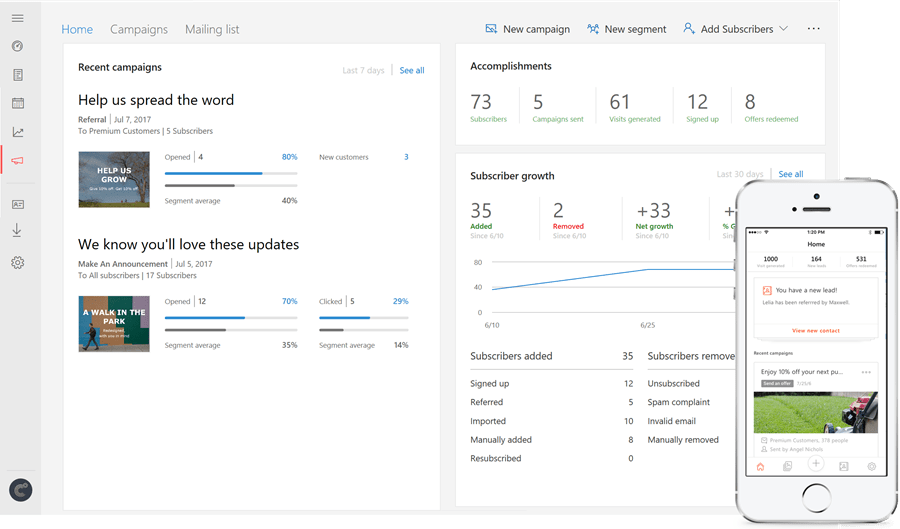
In the shadow of its Inspire partner conference, Microsoft today launched in preview three new tools for small businesses: Microsoft Connections, Microsoft Listings and Microsoft Invoicing. These join the company’s existing stable of small business tools like Microsoft Bookings and the Outlook Customer Manager.

Microsoft Connections allows its users to create Mailchimp-like email marketing campaigns. The new service, which is available on the web, Android and iOS, will offer the usual trappings of an email marketing campaign tool, including the ability to manage subscribers, monitor campaign performance (open rates, clicks, new customers, redemptions, etc.) and, of course, create the actual campaigns.

While the details about how exactly the service works remain sparse, Microsoft says it will offer users a number of pre-designed templates for their newsletters and “simple ways for people to join your mailing list or unsubscribe.” A company spokesperson also told us that the new tools will be available at no extra cost.

M2

The idea here is obviously to tie users deeper into the Office 365 ecosystem and give them an alternative to the likes of MailChimp. Microsoft argues that getting started with email marketing “can be overwhelming.” While its competitors will surely disagree, there can’t be any doubt that those small businesses that already use Office 365 as their productivity suite of choice will appreciate the addition of this new tool.

Also new is Microsoft Invoicing, a new tool for — you guessed it — creating invoices and estimates. From what we can see, it’s a pretty straightforward service and the standout feature for many businesses is likely that it can be integrated with PayPal so small businesses can easily accept credit card payments. There also is a QuickBooks connector that lets you connect your accounting software (and your accountant) with this new invoicing tool.

M3

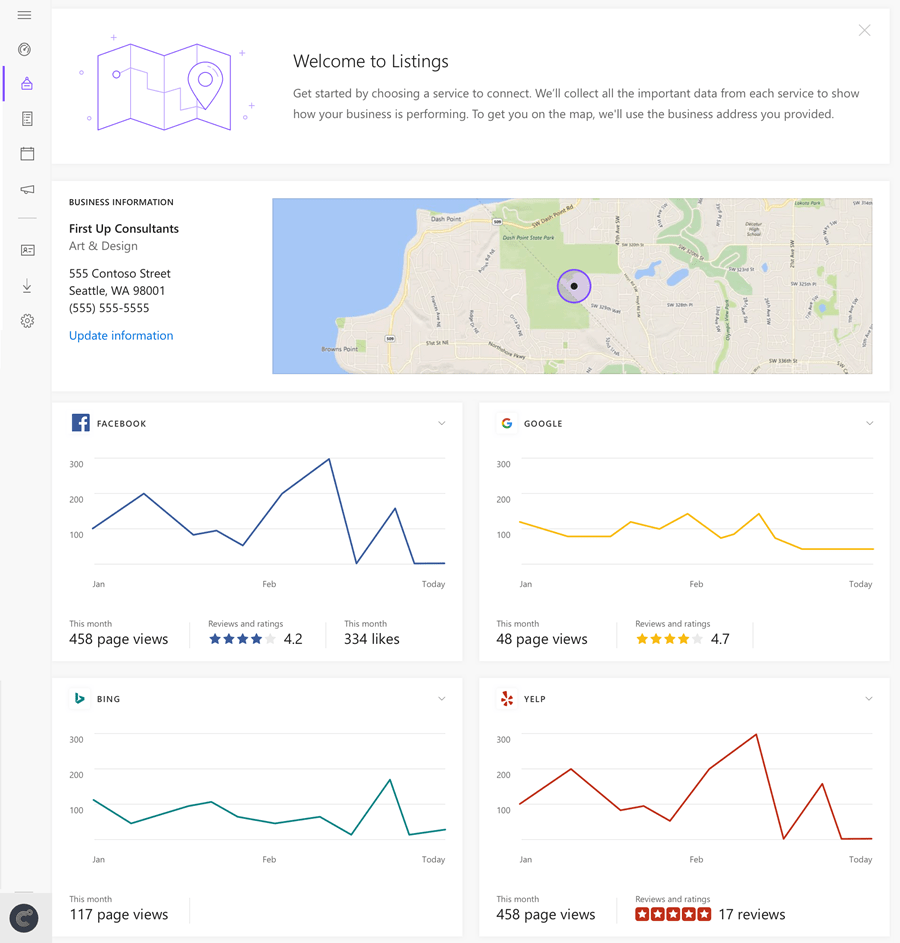
The third new tool is Microsoft Listings, which allows you to manage your business listings on Facebook, Google, Bing and Yelp and monitor online views and reviews. It obviously competes with a number of similar tools that do the same, but just like with the other new offerings, it’s a way for Microsoft to keep its users inside its own ecosystem.

The new applications are now available through Microsoft’s Office 365 First Release program.


Study: 4 ways good people make bad first impressions

By Monica Torres

Good_Impressions_Bragging-800x450

We know that managing our public self-image is critical to our careers, but too often the expectation of how we sound in our heads does not meet reality.

A new study in the Social and Personality Psychology Compass found that our biggest enemy in making a good impression is ourselves. We talk about our accomplishments and skills, not realizing that our attempt to give a favorable impression is backfiring. Instead of sounding competent and on top of things, we sound like obnoxious braggarts.
Researchers discovered that narcissism and a failure to account for the perspective of others were the repeated threads in our self-sabotaging presentation tactics. The worst part is that many of us can make these mistakes without ever realizing what’s making people back away.

In one experiment, participants were asked to speculate on what other people thought about their success story. What the participants thought went amazingly well, the bystanders were lukewarm on.

How to explain the divide? It’s all in the delivery. Where the participants wanted to play up how magical and unique their talent is, the people listening to the stories wanted the “hard work stories” participants told them to be relatable. They enjoyed the stories about how much time and effort went into our success more than the ones where we said it all came to us naturally. Put another way, people would rather hear about your guts than your glory.

What the test showed is that we can fail to take the perspective of others, at expense to ourselves. Worse, we don’t even realize we’re doing it, since at the time we’re too self-involved in our own stories. Here are four tactics to avoid so you don’t come off as an arrogant jerk.

1) Humblebragging
We place such a high value on sincerity that we prefer outright braggers to humblebraggers, researchers found.

Humblebraggers think talking about how they are such a hot mess who somehow managed to succeed makes them sound endearing. But disguising your accomplishments in a complaint or with humility makes you sound insincere; everyone knows the punchline of your story is how amazing you are.

It’s better to not conceal your intent, because when we see through an anecdote to its agenda, we react more negatively.

“Perceived insincerity is so critical for actors’ interpersonal appeal that humblebragging is less effective than simply complaining or bragging,” researchers said. “That is, both complainers and straightforward braggers are regarded as more sincere and thus more likable than humblebraggers.”

2) Backhanded compliments
Backhanded compliments appear fine on the surface until you hear the ulterior motives underneath. The example researchers gave was telling someone they “are smart for an intern.”

You may think this sounds like a compliment, but recipients will hear it as a strategic put-down to remind them of their place and of your superior status.

Known for being manipulative, narcissists frequently deploy these compliments to maintain superiority in the workplace, unwilling or unable to account for the feelings and perspective of others.

If you want to have a good laugh about this technique at its worst, read The Underminer: The Best Friend Who Casually Ruins Your Life . The book shares the monologue of that terrible person who always asks, “have you lost weight? You look so different! SO much better!”

As Lisa Zeidner once wrote of this technique, “You can’t escape this viper. Even if you sell all your belongings and move to New Zealand, you’ll bump into each other, get some fresh piece of bad news and be reminded of every failure in your past.”
No wonder people don’t like this behavior.

3) Hypocrisy
Hypocrites can actually skate by in public settings, using their self-enhancing lies to get ahead in the workplace. But the jig is up when people notice that they can’t back up what they boast.

Researchers found that we will judge hypocrites more harshly than individuals who did the same behavior—because we detest lying so much. So think twice before you decide to exaggerate your previous role; it’s very likely that no one is fooled — or fooled for long.

How to avoid hypocrisy? Keep your word, and back up what you brag about.

4) Hubris
We don’t react well to success stories that depend on putting someone else down. In an experiment, researchers had observers listen to an actor’s self-aggrandizing claims.
Statements that made social comparisons like “I am a better person to be friends with than others” turned us off more than non-comparison claims like “I am a good person to be friends with.”

This reaction is not because we believe in a fair and just world where everyone deserves equal treatment. Researchers believed that our reactions are a selfish, self-defense mechanism against the threat that the person with low opinions of others may have a low opinion of us.

“Observers disfavor the actor for self‐protective purposes…as they are threatened by the actor’s unfavorable view of them or gloomy perspective on their future—a state that sparks antagonism or hostility,” researchers said.

6 Ways to Break Bad Business Habits

By Meredith Wood, Fundera

thumbs

Learn how to avoid these common small business pitfalls so you can work smarter and truly enjoy being your own boss.

As a small business owner, you’re building a company from the ground up, and there are a lot of competing priorities and pressures. When you’re caught up in the day-to-day hustle and bustle of running your business, it can be easy to fall into some bad habits along the way.

Below we’ll explore six of the biggest bad business habits and reveal how to break them.

1. The Habit: Wearing Too Many Hats
In a recent survey, 35% of small business owners said they wished they could take on fewer roles and responsibilities.

Numerous studies show that multitasking is harmful for a variety of reasons—it increases stress, decreases productivity, and you’re far more likely to make mistakes in your work—but many entrepreneurs find themselves trapped wearing too many hats.

How to Break It: Delegation is key, but having someone to delegate to is the first step. Building a strong team that you trust allows you to feel more comfortable placing responsibilities in their capable hands. So, take your time during the hiring process.

Reach out to reliable contacts in your industry to widen your net, and consider not only work history, but also disposition and personality when interviewing.

2. The Habit: Getting Hung Up on Old Ideas
You probably dreamed about your company for a long time before you actually opened for business, and that means you have a strong vision for what you want it to be. While it’s important to have vision, trying to stick to a plan for achieving that vision—even when the plan has proven itself outdated or flawed—can cause big issues.

How to Break It: In order to change course, you have to be willing to let go of what was once a brilliant idea. As Dr. Alex Lickerman notes in Psychology Today, we tend to form biases towards our own ideas and opinions. Releasing those biases allows you the latitude to regroup and re-strategize as your company changes and grows.

3. The Habit: Over-Promising
Many small business owners have the urge to say yes to every request. However, agreeing to something that your company’s infrastructure or team can’t support ends up creating more ill will than just saying no in the first place.

How to Break It: Know your limits and stick to them. Take time to consider the request, but if it’s really something you can’t do, then offer a firm and simple “no.” Don’t go into details, as that invites the requestor to push the issue, and try to decline in-person or over the phone, since the tone of an email can sometimes be misconstrued.

4. The Habit: Not Taking Risks
The flip side of over-promising is not taking enough risks. Whether it’s fear of rejection, embarrassment, or financial failure, some small business owners lose their nerve just as their company is on the brink of a big breakthrough, thereby becoming their own worst enemies.

How to Break It: The first step to overcoming fear of failure is acknowledging that it exists; speak to trusted colleagues, friends, or family about your fears. The next step is focusing on things that are within your control. Turn your attention to tangibles, like redesigning your website or creating a new organizational tool for your merchandise.

5. The Habit: Micromanaging
Your business is your baby, and you want to do everything possible to make sure it succeeds. But micromanaging your employees is a guaranteed way to breed disengagement and resentment amongst your staff.

How to Break It: The urge to micromanage frequently springs from your own fear of failure or feelings of powerlessness. Facing those fears (see habit No. 4 above) will allow you to let go of those control-freak tendencies. Also strive to create a workplace culture of open communication; if your employees feel comfortable speaking to you when an issue arises, you’ll be at ease granting them more freedom.

6. The Habit: Not Taking Care of Yourself
With only 24 hours in the day, many small business owners aim to dedicate as many of those hours as possible to their business. Sleep, healthy eating, exercise and vacation time are de-prioritized or forsaken altogether. Not only is this dangerous for your physical and mental health, it can also take a toll on the health of your company.

How to Break It: The normative social influence, a force defined in social psychology, drives us to conform to a societal standard or preconceived notion of our role. Since the entrepreneurial role is seen as someone who works day and night, that’s what entrepreneurs feel pressured to do. Letting go of this pressure frees you up to achieve a healthy work-life balance, and to work with more focus and efficiency during the hours you do dedicate to your business.

Running your own business can be challenging, but it can also be one of the most rewarding endeavors you ever pursue. When you know how to avoid these common pitfalls, you’re able to work smarter and truly enjoy being your own boss.

Meredith Wood is the head of content and editor-in-chief at Fundera, an online marketplace for small business loans. Prior to Fundera, Meredith was the CCO at Funding Gates. Meredith manages financing columns on Inc, Entrepreneur, Huffington Post and more, and her advice can be seen on Yahoo, Daily Worth, Fox Business, American Express OPEN, Intuit, the SBA and many more.

The Six Essential Questions Your Business Plan Must Answer

By D.H. Lewis

six

“If you’re going to do it, do it right.”

That’s the advice my grandpa always gave me.
So now that you’re going to build a business plan for your project, you might as well go ahead and get it right. In this article we are going to discuss the essential questions your business plan must answer.

Basically, in order to impress your audience you need to answer six essential questions.

What problem are you going to solve?
Every business starts with a problem.
Your goal is to create riches making the lives of other people easier. That means scratching an itch, easing a pain or saving a life.

If the person evaluating your business plan can feel the pain, they will be much more inclined to believe in your solution.
In this section be specific.
Why is the problem important? How widespread is it?

How many people, who suffer this problem, are willing to pay for a solution?
Your next step is to quantify the potential of your target market.
Here you need to be brutally honest.

A business based on the idea of solving a problem for a remote village of impoverished people on the other side of the globe may be considered a noble cause, but will almost certainly raise doubts in the minds of someone hoping to invest in a viable business.
In this section you need to be able to establish both the size of your potential market and their willingness to pay for your solution.

Look for official statistics that document the number of people who suffer from the problem your solving and their income levels.
If you can prove that they are already paying for inferior solutions, even better!

What makes your solution better than what’s already out there?
No one wants to back “just another horse in the race.”

Even if you are entering an established marketplace with well known competitors, you need to find your own special angle that makes your proposition unique and compelling.
Can you bring a new technology to bear?

Do you have a special insight that makes your focus different?
Have you located a strategic location that makes your success more probable?

The objective of this section is to make the reader realize that you have really thought out a way of making your business stick out among the other players in the market.
Are you opening a franchise? In that case, explain why the proven formula from the head office is special and guarantees success.

Who is working with you to make this a success?
Often we think of businesses as the result of a sole heroic entrepreneur facing off against a world of obstacles and tests.

While it may at times feel that way, the truth is always far different.
Successful businesses are built by great teams working together.

No investor will believe that you are going to do everything and do it well.
If you are going to be launching the initiative by yourself, you will still need people to support your effort.

Can you create an advisory board of friends, family or colleagues who can bring a fresh viewpoint to the table?

Have you found the external professionals that will be working with you?
In this section you need to convince the reader that you have surrounded yourself with people who will help you overcome the difficulties that will certainly arise.
Businesses survive by selling their products and services.

How are you going to sell your products or services?
You may be a renowned expert in your field with years of experience.
You may have invented the most miraculous product ever seen.
You may have assembled a fabulous team to back your idea.

However, if you don’t have a clear and convincing way to reach your market and make the sale, your whole plan is crippled.

In this section you need to explain how you are going to market and sell to your market.
How much do you expect acquiring each new customer going to cost?
How are you going to communicate with them?
What is the sales funnel you are going to build?
Never, show your business plan to anyone until you’ve gotten this section right.

How are you going to organize your business that assures profits?
Finally, your business plan needs to address the nuts and bolts of managing a successful business.

Although we all love to talk about innovations, marketing strategies and great team members who are joining the company, the truth is that far too often businesses fail due to mundane everyday problems.

In this section of your business plan you need to show that you’ve prepared for these problems.

What is your cashflow going to look like?

How much capital do you need to cross the line from losses to profits?

Crunching the numbers and presenting a coherent financial plan has less to do with predicting the future than showing that you have done your homework.

Remember that the analyst who is reading your plan has seen a thousand plans.
They know the tricks and can spot your “glossed over” sections a mile away.

By studying your plan they aren’t looking to see how much money you’re going to bring in in month six. Instead they are going to be asking themselves questions like “is this reasonable?” or “does this plan make sense?” A great business plan proves that you’re capable of planning and thinking through the dangers ahead.

You may believe that their decisions will be based on the merits of your plan, but the truth is that they will be based on the merits of the person presenting the plan.

If you demonstrate that you’ve done your homework and are prepared to take on the difficulties ahead, your plan will be a success. Now go back and read through your business plan.

10 toxic people you should avoid like the plague

By Travis Bradberry

Toxic_People_To_Avoid

Toxic people defy logic. Some are blissfully unaware of the negative impact that they have on those around them, and others seem to derive satisfaction from creating chaos and pushing other people’s buttons.

As important as it is to learn how to deal with different kinds of people, truly toxic people will never be worth your time and energy — and they take a lot of each. Toxic people create unnecessary complexity, strife, and, worst of all, stress.
“People inspire you, or they drain you — pick them wisely.” – Hans F. Hansen

Recent research from Friedrich Schiller University in Germany shows just how serious toxic people are. They found that exposure to stimuli that cause strong negative emotions — the same kind of exposure you get when dealing with toxic people — caused subjects’ brains to have a massive stress response.

Whether it’s negativity, cruelty, the victim syndrome, or just plain craziness, toxic people drive your brain into a stressed-out state that should be avoided at all costs.

Studies have long shown that stress can have a lasting, negative impact on the brain. Exposure to even a few days of stress compromises the effectiveness of neurons in the hippocampus, an important brain area responsible for reasoning and memory. Weeks of stress cause reversible damage to brain cells, and months of stress can permanently destroy them. Toxic people don’t just make you miserable — they’re really hard on your brain.

The ability to manage your emotions and remain calm under pressure has a direct link to your performance. TalentSmart has conducted research with more than a million people, and we’ve found that 90% of top performers are skilled at managing their emotions in times of stress in order to remain calm and in control. One of their greatest gifts is the ability to identify toxic people and keep them at bay.

It’s often said that you’re the product of the five people you spend the most time with. If you allow even one of those five people to be toxic, you’ll soon find out how capable he or she is of holding you back.

You can’t hope to distance yourself from toxic people until you first know who they are. The trick is to separate those who are annoying or simply difficult from those who are truly toxic. What follows are ten types of toxic drainers that you should stay away from at all costs so that you don’t become one yourself.

1. The gossip
“Great minds discuss ideas, average ones discuss events, and small minds discuss people.” – Eleanor Roosevelt

Gossipers derive pleasure from other people’s misfortunes. It might be fun to peer into somebody else’s personal or professional faux pas at first, but over time, it gets tiring, makes you feel gross, and hurts other people.

There are too many positives out there and too much to learn from interesting people to waste your time talking about the misfortune of others.

2. The temperamental
Some people have absolutely no control over their emotions. They will lash out at you and project their feelings onto you, all the while thinking that you’re the one causing their malaise. Temperamental people are tough to dump from your life because their lack of control over their emotions makes you feel bad for them.

When push comes to shove though, temperamental people will use you as their emotional toilet and should be avoided at all costs.

3. The Victim
Victims are tough to identify because you initially empathize with their problems. But as time passes, you begin to realize that their “time of need” is all the time. Victims actively push away any personal responsibility by making every speed bump they encounter into an uncrossable mountain. They don’t see tough times as opportunities to learn and grow from; instead, they see them as an out.

There’s an old saying: “Pain is inevitable but suffering is optional.” It perfectly captures the toxicity of the victim, who chooses to suffer every time.

4. The self-absorbed
Self-absorbed people bring you down through the impassionate distance they maintain from other people. You can usually tell when you’re hanging around self-absorbed people because you start to feel completely alone.

This happens because as far as they’re concerned, there’s no point in having a real connection between them and anyone else. You’re merely a tool used to build their self-esteem.

5. The envious
To envious people, the grass is always greener somewhere else. Even when something great happens to envious people, they don’t derive any satisfaction from it. This is because they measure their fortune against the world’s when they should be deriving their satisfaction from within.

And let’s face it, there’s always someone out there who’s doing better if you look hard enough. Spending too much time around envious people is dangerous because they teach you to trivialize your own accomplishments.

6. The manipulator
Manipulators suck time and energy out of your life under the façade of friendship. They can be tricky to deal with because they treat you like a friend. They know what you like, what makes you happy, and what you think is funny, but the difference is that they use this information as part of a hidden agenda.

Manipulators always want something from you, and if you look back on your relationships with them, it’s all take, take, take, with little or no giving. They’ll do anything to win you over just so they can work you over.

7. The dementor
In J. K. Rowling’s “Harry Potter” series, Dementors are evil creatures that suck people’s souls out of their bodies, leaving them merely as shells of humans. Whenever a Dementor enters the room, it goes dark, people get cold, and they begin to recall their worst memories. Rowling said that she developed the concept for Dementors based on highly negative people—the kind of people who have the ability to walk into a room and instantly suck the life out of it.

Dementors suck the life out of the room by imposing their negativity and pessimism upon everyone they encounter. Their viewpoints are always glass half empty, and they can inject fear and concern into even the most benign situations. A Notre Dame University study found that students assigned to roommates who thought negatively were far more likely to develop negative thinking and even depression themselves.

8. The twisted
There are certain toxic people who have bad intentions, deriving deep satisfaction from the pain and misery of others. They are either out to hurt you, to make you feel bad, or to get something from you; otherwise, they have no interest in you. The only good thing about this type is that you can spot their intentions quickly, which makes it that much faster to get them out of your life.

9. The judgmental
Judgmental people are quick to tell you exactly what is and isn’t cool. They have a way of taking the thing you’re most passionate about and making you feel terrible about it.
Instead of appreciating and learning from people who are different from them, judgmental people look down on others. Judgmental people stifle your desire to be a passionate, expressive person, so you’re best off cutting them out and being yourself.

10. The arrogant
Arrogant people are a waste of your time because they see everything you do as a personal challenge. Arrogance is false confidence, and it always masks major insecurities. A University of Akron study found that arrogance is correlated with a slew of problems in the workplace.

Arrogant people tend to be lower performers, more disagreeable, and have more cognitive problems than the average person.

How to protect yourself once you spot ‘em

Toxic people drive you crazy because their behavior is so irrational. Make no mistake about it — their behavior truly goes against reason, so why do you allow yourself to respond to them emotionally and get sucked into the mix?

The more irrational and off-base someone is, the easier it should be for you to remove yourself from their traps. Quit trying to beat them at their own game. Distance yourself from them emotionally, and approach your interactions with them like they’re a science project (or you’re their shrink if you prefer that analogy). You don’t need to respond to the emotional chaos — only the facts.

Maintaining an emotional distance requires awareness. You can’t stop someone from pushing your buttons if you don’t recognize when it’s happening. Sometimes you’ll find yourself in situations where you’ll need to regroup and choose the best way forward. This is fine, and you shouldn’t be afraid to buy yourself some time to do so.

Most people feel as though because they work or live with someone, they have no way to control the chaos. This couldn’t be further from the truth. Once you’ve identified a toxic person, you’ll begin to find their behavior more predictable and easier to understand. This will equip you to think rationally about when and where you have to put up with them and when and where you don’t.

You can establish boundaries, but you’ll have to do so consciously and proactively. If you let things happen naturally, you’re bound to find yourself constantly embroiled in difficult conversations. If you set boundaries and decide when and where you’ll engage a difficult person, you can control much of the chaos. The only trick is to stick to your guns and keep boundaries in place when the person tries to cross them, which they will.

Travis Bradberry is the coauthor of Emotional Intelligence 2.0 and the cofounder of TalentSmart.